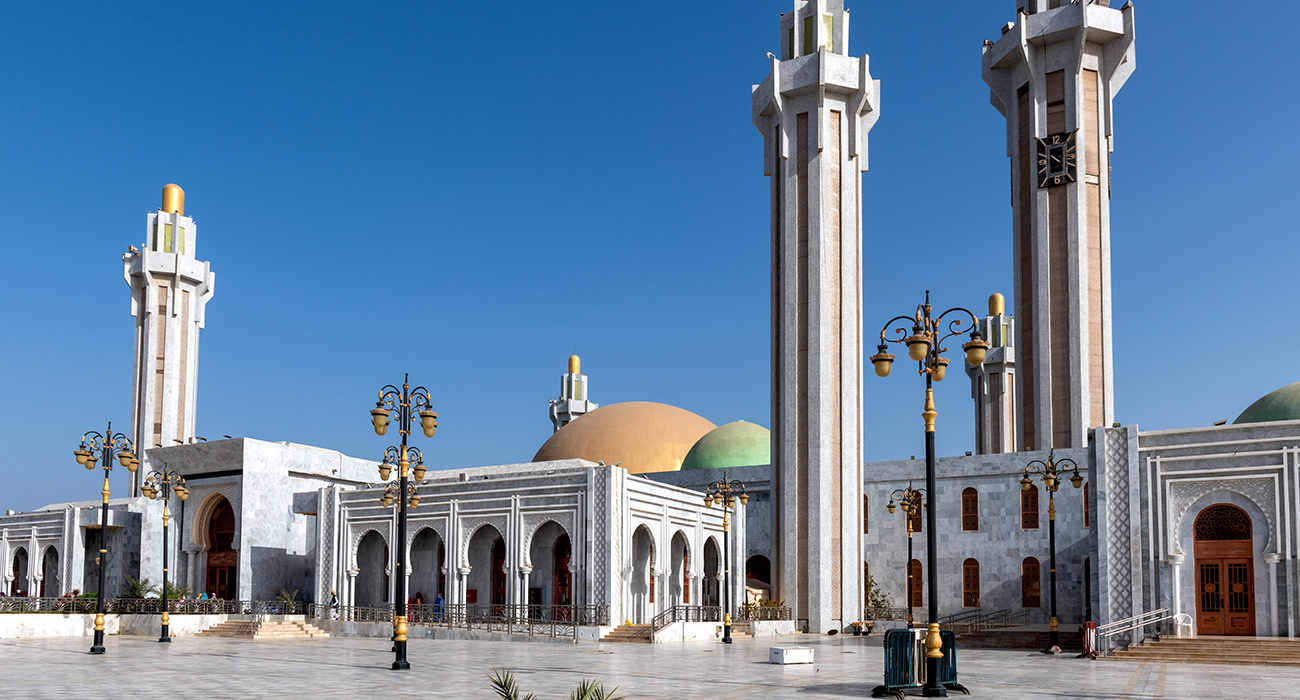
In the heart of Dakar, the Great Mosque of Dakar stands as one of Senegal’s major religious and architectural landmarks. Inaugurated in 1964 by King Hassan II of Morocco, President Léopold Sédar Senghor, and numerous religious dignitaries, it symbolizes both the modernity of post-independence Senegal, the country’s Arab-Muslim heritage, and the central role of faith in the urban life of the capital.
Its colossal 67 m minaret, richly decorated façades with Moroccan mosaics, and vast prayer hall welcoming thousands of worshippers every Friday make the Great Mosque both imposing and welcoming, attracting believers, visitors, and lovers of monumental art. More than just a place of worship, it embodies diversity, social cohesion, and Senegalese architectural excellence.
History of the great Mosque
The decision to build the mosque came shortly after the country’s independence in 1960, driven by the desire to provide the capital with a monument reflecting the place of Islam and Senegal’s connection to the Muslim world. The first stone was laid in 1961, and the inauguration took place on March 27, 1964, in the presence of King Hassan II, who largely funded the project and enlisted his finest artisans for the interior decoration.
This Franco-Moroccan collaboration is reflected in the building’s Arab-Andalusian style and the intricate mosaics crafted in Fès and Marrakech. French and Moroccan architects were supported by Senegalese artisans – notably Momar Ndiaye, a famous lightning rod welder, who became a well-known figure in Dakar’s Muslim community.
Moroccan-Inspired architecture
The Great Mosque is remarkable in several ways:
- The minaret: 67 m high, visible from surrounding neighborhoods, adorned with geometric and calligraphic Islamic motifs; it dominates the Dakar skyline.
- The façades: covered with white Carrara marble, colorful mosaics, and patterns inspired by Moroccan art schools.
- The dome: green and gold, crowning the main prayer hall, which, with crystal chandeliers and luxurious carpets, can accommodate thousands of worshippers.
- Gardens and esplanades: tree-lined spaces for gathering and discussion after prayers.
- Details: hand-carved stucco, local wooden doors decorated by Senegalese artisans; the design combines modernity (reinforced concrete) with tradition (Arab-Andalusian decorations).
The complex also includes the Islamic Institute, created in 1974, a center for Islamic education and research, featuring a large library donated by Saudi Prince Nayef bin Abdelaziz.
Religious life and community role
The Great Mosque comes alive during prayer times, especially on Fridays, when a multigenerational crowd gathers on the esplanade.
It hosts major Muslim festivals (Eid al-Fitr, Eid al-Adha), conferences, teachings, and community gatherings, occupying a central role in Dakar’s life.
Within its decorated halls, sermons, preaching, and Quranic recitation punctuate daily life, reflecting a diverse community – Wolofs, Peuls, Toucouleurs, Berbers, Lebanese – united in common worship. The Islamic Institute trains imams and researchers annually and promotes interreligious dialogue.
Anecdote about the Great Mosque of Dakar
- The minaret’s lightning rod, essential due to the building’s height, was welded by Senegalese worker Momar Ndiaye, whose reputation earned lasting recognition for his family within Dakar’s Muslim community.
What to do at the great Mosque of Dakar
- Admire the exterior architecture: minaret, dome, mosaics, ornate doors.
- Explore the interior (outside prayer times), a vast space illuminated by chandeliers.
- Participate in Friday prayer (for Muslims) or observe the lively crowd on the esplanade.
- Explore the surroundings: central market, bustling streets, Place de l’Indépendance, colonial port.
- Walk around the building to appreciate the blend of Senegalese, Moroccan, and Maghrebian design influences.
Practical information
- Location: Boulevard de la République / Allée Pape Gueye Fall, downtown Dakar.
- Access: taxi, public transport, or walking from Plateau or Médina.
- Hours: open daily, prayers five times a day (visitor entry mostly outside prayer times), main service Friday at noon.
- Entrance: free, donations welcome.
- Dress code: modest clothing, women veiled, shoes removed in prayer hall.
- Facilities: toilets, libraries, teaching centers, visitor reception (official guides available).
- Best time to visit: outside prayer times, or during Eid/festivals for a unique atmosphere.