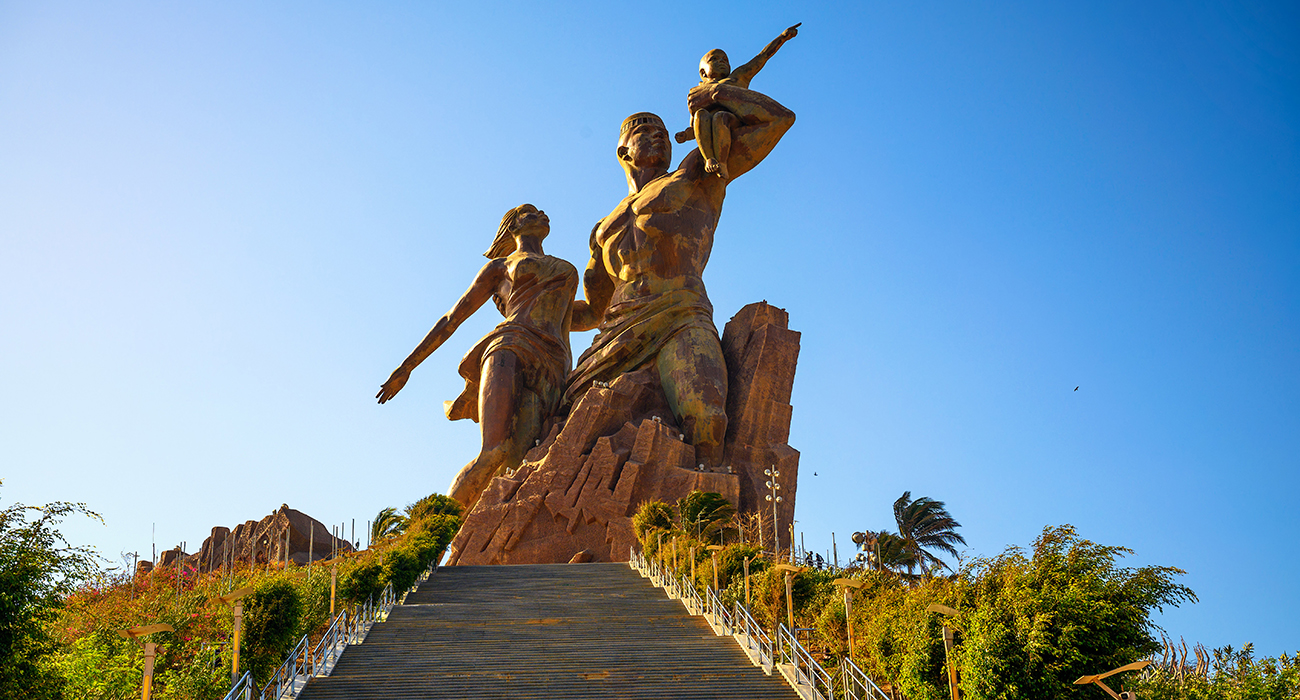
Perched on the Mamelles Hill (about 100m), the African Renaissance Monument overlooks Dakar and the Atlantic from its 52-meter height, making it the tallest statue in Africa. Inaugurated in 2010, it represents an African family looking toward the future and symbolizes the continent’s regained pride after centuries of colonization. Today, it stands as an essential tourist, cultural, and political landmark. It is visible from many locations in the capital and accessible via a monumental staircase.
Origin and history
The monument was conceived by President Abdoulaye Wade, determined in 2002 to provide Africa with a symbol as imposing and emblematic as the Statue of Liberty or Christ the Redeemer in Rio. The construction was carried out by Senegalese engineers and artists, in collaboration with Virgil Magherusan and a North Korean company. The bronze and copper colossus was inaugurated on April 4, 2010, the 50th anniversary of independence, in the presence of numerous African heads of state.
Monumental Architecture
- Height: 52 m without the pedestal, taller than the Statue of Liberty, which is 46 m.
- Representation: The statue depicts a family (man, woman, child) emerging from the ground, facing west. The man carries the child on his left arm while his right hand encircles the woman. This symbolizes Africa’s transition from darkness to light and a better future, with the sun representing the continent’s openness to the world.
- Weight: nearly 22,000 tons of bronze and copper.
- Style: Modern architecture, highly expressive figures, dynamic lines: deliberately monumental and internationalist aesthetic.
- Access: A staircase of 198 steps climbs the hill to the base of the monument.
A Pan-African symbol
Designed to symbolize continental pride, the monument represents, according to its creator, the “emergence from the darkness” of colonization, family unity, and the hope of future generations represented by the child raised toward the horizon.
It hosts national celebrations, popular gatherings, and visits by African and foreign dignitaries. Its orientation toward the Atlantic also symbolizes the continent’s openness to the world.
Exceptional panorama
The internal elevator (accessible via the hall, which also houses a museum) leads to a platform located in the male figure’s head, over 150 m above ground: the view offers a 360° panorama of the coastline, Dakar, Ngor, the Cap-Vert peninsula, and the Pointe des Almadies.
Museum and exhibitions
Inside the monument’s base, a museum presents:
- The history of the African continent.
- Temporary exhibitions of contemporary African art and crafts.
- Murals, videos, and slideshows on the monument’s construction stages and the history of the “Renaissance” project.
Guided tours (including the elevator) are available in several languages.
Cultural life around the monument
Throughout the year, various cultural and artistic events are organized on the monument’s large plaza and staircase:
- Concerts, art exhibitions, conferences, workshops, etc.
- Sports events, urban art exhibitions (graffiti along the base and promenade).
- Many street vendors, visiting students, photographers, and Senegalese families on weekend outings.
Anecdotes about the African Renaissance Monument
- The exact number of steps to reach the statue’s base is officially 198.
- During the inauguration, President Wade declared, “Africa will never be the same again,” symbolically lighting the monument with a laser beam visible across the city at night.
- At night, the statue is sometimes illuminated for special occasions.
What to do at the African Renaissance Monument?
- Go up to the panoramic platform (via the internal elevator) for an exceptional view of the peninsula and the ocean.
- Explore the museum and exhibitions in the base (modernity, history, African figures).
- Stroll around the monumental esplanade: take sunset photos, wander among visitors, and enjoy the lively atmosphere.
- Visit nearby sites such as the Mamelles Lighthouse and the Divinity Mosque, located less than 10 minutes away.
Practical information
- Location: Western Mamelles Hills, Ouakam district, Dakar.
- Access: By car, taxi, or bus from downtown (20–30 min depending on traffic).
- Hours: Daily from 9:00 AM to 7:45 PM.
- Admission: Children/residents 500 FCFA; adult residents—basic visit 1000 FCFA, panoramic platform 3000 FCFA; non-resident adults 10 € / 6,500 FCFA; non-resident children 5 € / 3,250 FCFA.
- Tips: Visit late in the day for golden light and pleasant temperatures; bring camera/video equipment.