AFCON 2025 is now being played out in a courtroom, but in Senegal, nobody waited for the judges to know what they had lived through. On 18 January 2026, in Rabat, the Lions beat Morocco 1-0 after extra time, at the end of an extraordinary final. Two months later, the Confederation of African Football (CAF) stripped them of the title in the boardroom, and the Court of Arbitration for Sport (CAS) is examining Senegal’s appeal. If you want to understand this country, forget the official roll of honour for a moment and look at the passion instead: you can go and see it, from Diamniadio to the beaches of Yoff.
At a glance
| Competition | 2025 Africa Cup of Nations (AFCON 2025), in Morocco, from late December 2025 to 18 January 2026 |
| On the pitch | Final won by Senegal, 1-0 after extra time against Morocco, in Rabat |
| Goalscorer | Pape Gueye, early in extra time |
| Head coach | Pape Thiaw |
| Player of the tournament | Sadio Mané |
| Official status at 8 October 2026 | Title awarded to Morocco by the CAF Appeal Board (17 March 2026), Senegal’s appeal before CAS |
| Next step | CAS hearing held in Lausanne on 8 October 2026; case under deliberation, award on a date not yet announced |
| Where to experience football | Abdoulaye Wade Stadium (Diamniadio), Léopold Sédar Senghor Stadium (Dakar), navétanes (neighbourhood football tournaments), beaches |
| With QFS | Transfers, wrestling, Dakar tours, up to 30% off for residents |
Rabat, 18 January 2026: the final that did not end with the whistle
The Lions’ campaign looked like a calm demonstration. Top of Group D with two wins and a draw, including a 3-0 win over Benin to finish, they knocked out Sudan in the round of 16, then Mali in the quarter-finals (1-0, goal by Iliman Ndiaye) and Egypt in the semi-final (1-0, a volley by Sadio Mané). Facing them in the final: the host nation, carried by its crowd at the Prince Moulay Abdellah Stadium in Rabat.
The final turned in stoppage time. A penalty was awarded to Morocco after a video review; several Senegalese players, protesting against the refereeing, temporarily left the pitch, and the match was suspended for long minutes amid extreme tension. When play resumed, Brahim Díaz attempted a Panenka that Édouard Mendy gathered in his arms. Early in extra time, Pape Gueye sent a shot into the top corner. Senegal held on to the end and lifted the trophy that night, four years after winning AFCON 2021 in February 2022 in Cameroon, against Egypt, on penalties. A trophy that CAF would take away from them two months later.
Two days after the final, Dakar gave the players a sea of people: a bus setting off from Diamniadio, the motorway lined with fans, Rufisque, Thiaroye, Patte d’Oie, then the Presidential Palace (Palais de la République), where President Bassirou Diomaye Faye received the team.
Timeline of a disputed title
| Date | Event |
|---|
| 14 January 2026 | Semi-final: Senegal 1-0 Egypt |
| 18 January 2026 | Final in Rabat: Senegal 1-0 Morocco after extra time, following an interruption of the match |
| Two days later | The Lions return home, parade from Diamniadio to the Presidential Palace |
| After the final | First CAF disciplinary sanctions, result of the final upheld |
| 17 March 2026 | The CAF Appeal Board, on a complaint from the Moroccan federation, declares that Senegal forfeited the match (3-0) and names Morocco champions |
| 25 March 2026 | The Senegalese Football Federation takes the case to CAS |
| 8 October 2026 | CAS hearing in Lausanne, behind closed doors; the case goes to deliberation |
The heart of the dispute is the Senegalese players’ temporary walk-off: CAF saw it as abandoning the pitch, an offence punished under the competition rules; Senegal contests that reading and is asking for the decision to be overturned outright. CAS can uphold it, overturn it or amend it. The subject is a burning one on both sides, and we will not settle it here. Simply bear in mind that, in Senegal, the Rabat final remains a victory people lived through, and that it is best approached tactfully with the people you talk to, Senegalese and Moroccan alike.
Resident or visitor: two ways into the passion
If you live in Senegal, you already know that football sets the rhythm of the year: Lions matches that empty the streets of traffic, the navétanes that set the rainy season (hivernage) alight, the sand pitches where people play until nightfall. The smart move is to see things up close: a match in Diamniadio, getting there on the TER (Regional Express Train), a navétanes final in a neighbourhood other than your own, a Sunday of football on Yoff beach. For the outings that go with it, you get the resident rate on our activities: up to 30% off.
If you are just passing through, football is the easiest way into Senegalese life: a Lions shirt is all it takes to strike up a conversation with a driver, a vendor or a group of teenagers. There is no need to chase after a big match: you come across the passion everywhere, on the Corniche at sunset, in a neighbourhood courtyard on a match night, in front of a television set up on a shop counter.
Where to experience football in Senegal
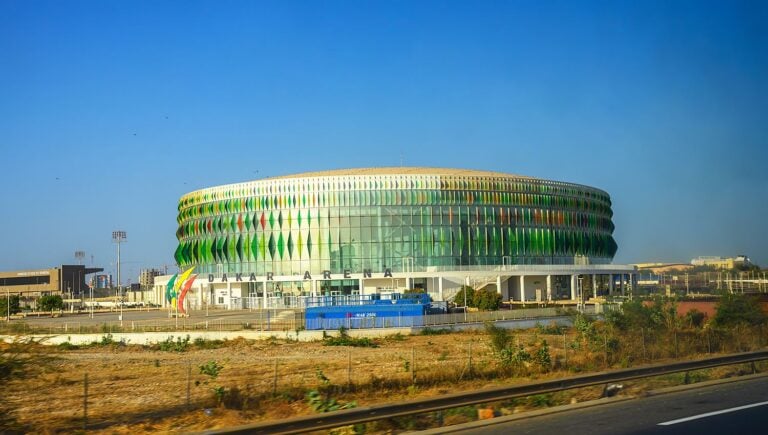
Abdoulaye Wade Stadium, in Diamniadio
Inaugurated on 22 February 2022, a few days after the first continental title, the stadium in Diamniadio holds 50,000 people: it is the biggest stage in Senegalese football. It lies some thirty kilometres from Dakar, in the new town, and the TER stops there: it is by far the most stress-free way to get there on a match night, as the motorway gets jammed. During the Dakar 2026 Youth Olympic Games (YOG), from 31 October to 13 November 2026, it will host the archery.
Léopold Sédar Senghor Stadium, in Dakar
The historic home of Senegalese football was renovated over nearly three years and handed over in April 2025, with around 54,000 seats. It stands on the Grand Yoff side, on the Yoff airport road.
The navétanes, the real people’s championship
The word comes from the Wolof nawet, the rainy season. During the long summer holidays, neighbourhood sports and cultural associations (ASC) compete by zone, under the aegis of a national body, ONCAV, up to the national stages at the end of the season. In the Dakar Region alone, more than 340 associations take part. The atmosphere is that of a neighbourhood party, with drums, songs and the neighbourhood’s honour at stake. Be aware that some matches are tense: ask locally before you go, and follow your neighbours’ lead.
The beaches, open-air pitches
In Dakar and on the Petite Côte, football is played on the sand as soon as the heat drops: on the long beach at Yoff, on Ngor beach, and as far as the village beaches of the Petite Côte, where children play between the pirogues. It is no coincidence that Senegal dominates African beach soccer: in 2024, it won an eighth continental title, a record, and its fifth in a row.
A football weekend in Dakar
On Saturday morning, start with the Plateau and the Médina, where the Lions shirt is worn like a second skin; in the afternoon, climb up to the African Renaissance Monument for the view over the peninsula, then finish on the Corniche or in Yoff, where the sand turns into a pitch at sunset. On Sunday, take the TER to Diamniadio if a match is scheduled, or spend the day in Ngor, between the island and the beach. For a broader programme, our ideal 3-day itinerary in Dakar provides the framework.
Practical tips
- Match tickets: buy them only through the official channels announced by the federation, and beware of touts at the entrance.
- Arrival: come early, with water, a hat and few valuables; the areas around the stadiums are very crowded before and after matches.
- Transport: for Diamniadio, choose the TER; in Dakar, arrange your return in advance, as taxis are scarce when the crowds come out.
- Clothing: a green, yellow and red shirt is the best passport; in the neighbourhoods, modest clothing covering the shoulders and knees remains the rule.
- Photography: ask before photographing fans or children, especially in the neighbourhoods.
- Conversation: the Rabat final is a sensitive subject; listen before giving your opinion.
Book an activity with QFS
Football whets the appetite for the rest of Senegal’s sporting culture. Senegalese wrestling, the other national passion, can be discovered in a taster session or on an outing to understand the rituals of the bout; personal training & fitness often takes place facing the sea, and surf lessons & camps carry on the beach spirit. For the city, guided cultural tours tell the story of Dakar neighbourhood by neighbourhood, and vehicle hire with driver saves you hunting for a taxi outside a stadium. For families, have a look at family days & children’s outings.
You pay 20% to secure your booking (the booking fee), and the balance is paid on site, on the day. Match tickets are not sold through QFS. If you live in Senegal, you get the resident rate: up to 30% off depending on the activity (the exact rate is shown on each listing; see Resident sign-up).
Frequently asked questions
Did Senegal win AFCON 2025?
On the pitch, yes: they beat Morocco 1-0 after extra time in the final, on 18 January 2026 in Rabat. But on 17 March 2026, the CAF Appeal Board declared that Senegal had forfeited the match and named Morocco champions; Senegal has appealed to CAS.
When will CAS give its decision?
The hearing was held in Lausanne on 8 October 2026, behind closed doors, and the case is now under deliberation. CAS has not announced a date for its award.
Who scored in the final and who saved the penalty?
Pape Gueye scored early in extra time. Just before, in stoppage time, Édouard Mendy had saved Brahim Díaz’s Panenka.
How do you get to Abdoulaye Wade Stadium from Dakar?
The stadium is in Diamniadio, some thirty kilometres from Dakar, and the TER stops there. On a match night, the train is more reliable than the road, which is often jammed.
What are the navétanes?
They are the popular neighbourhood football championships, played during the long summer holidays and the rainy season by sports and cultural associations, under the aegis of ONCAV.