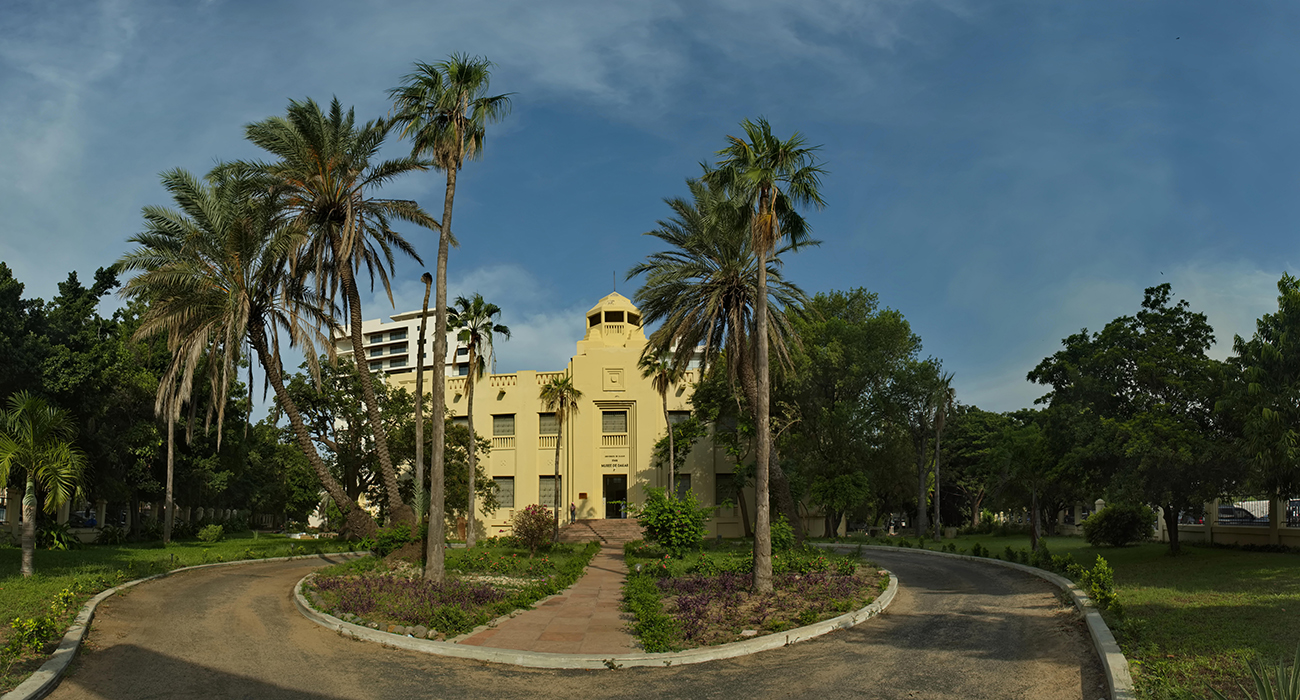
The Théodore Monod Museum of African Art has one flaw you are going to love: few visitors go in. On Place Soweto, in the heart of the Plateau, this 1930s building holds a collection of more than 9,000 objects from West Africa, gathered since the late 1930s by generations of researchers, and you may well have a room full of masks all to yourself. If the Museum of Black Civilisations tells the grand story of the continent, this one puts you face to face with the objects themselves, up close, with no crowds and no screens.
At a glance
| Region | Dakar Region, Dakar department, Dakar-Plateau district municipality (commune d’arrondissement) |
| Address | Place Soweto, on the Plateau, a stone’s throw from the National Assembly |
| Type | Museum of African art run by IFAN Cheikh Anta Diop (Cheikh Anta Diop University of Dakar) |
| Getting there from Dakar | In the city centre: 10 to 20 minutes on foot from Place de l’Indépendance; by taxi from the Almadies, from 20 minutes to nearly an hour depending on traffic; TER (Regional Express Train) to Dakar station, including from Blaise Diagne International Airport (AIBD) |
| Opening hours | Tuesday to Sunday, 09:00–17:00; closed on Mondays |
| Recommended time | 1 to 1½ hours; half a day if you combine it with a walk around the Plateau |
| Official fees | Museum admission, displayed at the ticket desk, payable on site and not included in the price |
| Best time to go | All year round; on a weekday, in the morning; an ideal refuge in the hot hours of the rainy season (hivernage) |
| Related QFS activities | Guided cultural tours, crafts, dyeing, drumming and dance workshops |
Resident or visitor: a museum that rewards you differently
If you live in Senegal, there is a good chance you have walked past Place Soweto a hundred times without going in. That is the mistake to put right. The museum makes an easy outing close to home, on a Saturday morning, with curious children or with family and friends passing through: in an hour, it gives a very concrete idea of the diversity of West African cultures, from Dogon country to the kingdoms of the Gulf of Guinea. Come back for the temporary exhibitions and during Dak’Art, the Dakar Biennale, for which the museum is a regular venue: the building then changes face, and contemporary art enters into dialogue with the older pieces.
If you are a visitor, put it at the very start of your stay. Before the craft market, before the workshops, before Gorée, it teaches you how to look: the difference between a dance mask and a decorative object, the place of weaving, the role of instruments in social life. After that, you will never see the stalls of the Plateau in the same way. Allow an hour, an hour and a half if you read the labels; and pair it with the Museum of Black Civilisations, more recent and more spectacular, for a coherent day of museums: one for the objects, the other for the story.
A museum born of a research institute
IFAN, the parent institution
To understand this museum, you have to start with the institution that created it. In 1936, the colonial administration founded the Institut français d’Afrique noire (French Institute of Black Africa), IFAN, in Dakar, to study the societies, languages, history and natural world of West Africa, and to build up scientific collections for that purpose. The institute actually opened its doors in 1938, under the direction of the naturalist Théodore Monod, who would lead it until the mid-1960s. Its researchers brought back thousands of objects from their missions: masks, statuettes, tools, ornaments, fabrics, musical instruments.
At independence, the institute was absorbed into the University of Dakar, then changed its name in the mid-1960s to become the Institut fondamental d’Afrique noire (Fundamental Institute of Black Africa), keeping its acronym. After the death of the Senegalese historian and anthropologist Cheikh Anta Diop in 1986, both the institute and the university took his name. It is still IFAN Cheikh Anta Diop, part of Cheikh Anta Diop University, that runs the museum today.
From the institute’s headquarters to a museum
The building on Place Soweto was built in 1931–1932 in a style known as neo-Sudanese, which borrows the volumes and decoration of the earthen architecture of the Sahel. It housed IFAN until the institute moved to a new campus, around the time of independence. Once vacated, the building was turned into an ethnographic museum and opened to the public in the early 1960s. For decades, Dakar residents simply called it “the IFAN museum”.
Later, a second, more modern building was added: it hosts temporary exhibitions and events, while the historic building keeps the stores and the permanent exhibition.
Why “Théodore Monod”
In 2007, the museum officially took the name of Théodore Monod, who died in 2000. The choice was a logical one: a naturalist, geologist and great explorer of the Sahara, Monod spent nearly thirty years building IFAN and assembling its collections. You will still hear many people in Dakar talk about the “IFAN museum”: it is the same place.
1966, the year Dakar looked at African art
In April 1966, Dakar hosted the first World Festival of Black Arts, championed by President Léopold Sédar Senghor. The flagship exhibition, devoted to classical African art, was held not on Place Soweto but at the Musée dynamique, a building put up for the occasion, before being shown in Paris. The festival nonetheless marked the museum’s history: for the first time, it made Dakar a capital where Africa exhibited its own heritage, an ambition the IFAN museum had already been pursuing since the start of the decade.
Key facts & figures
| Fact | Figure | Note |
|---|
| Founding of IFAN | 1936 | Actually opened in 1938 |
| Construction of the building | 1931–1932 | Neo-Sudanese style |
| Théodore Monod as director | From 1938 to the mid-1960s | First director of the institute |
| Opening as a museum | Early 1960s | After IFAN moved to its new campus |
| Cheikh Anta Diop’s name given to IFAN | Late 1980s | After the historian’s death in 1986 |
| Théodore Monod’s name given to the museum | 2007 | Monod died in 2000 |
| Collections | More than 9,000 objects | Mostly from West Africa |
| First World Festival of Black Arts | April 1966 | Major exhibition at the Musée dynamique |
| Closing day | Monday | Open Tuesday to Sunday, 09:00–17:00 |
Getting there & official fees
The museum stands on Place Soweto, a stone’s throw from the National Assembly, in the southern part of the Plateau. From Place de l’Indépendance, allow 10 to 20 minutes on foot; from Dakar station, the TER terminus, about twenty minutes on foot or a few minutes by taxi. From the western districts, the Almadies, Ngor or Ouakam, take a taxi and agree the fare before you get in, and allow plenty of time at rush hour: the same ride can take anything from 20 minutes to nearly an hour.
Opening hours: Tuesday to Sunday, 09:00–17:00. The museum is closed on Mondays, like the Museum of Black Civilisations and the House of Slaves on Gorée: do not plan your cultural day for a Monday.
Official fees: museum admission follows the rates set by the institution and displayed at the ticket desk. It is paid on site, is not included in the price of activities and is not covered by the QFS resident rate. Bring cash, in small notes.
What to see
Masks and statuary. This is the heart of the permanent exhibition. Dance masks, ancestor figures, ritual objects from Mali, Côte d’Ivoire, Burkina Faso, Guinea-Bissau, Benin or Nigeria: among other things, you will see wooden sculptures from Dogon country and bronzes from the Gulf of Guinea. Take the time to read where each piece comes from: the diversity of styles, from one country to the next, is the real lesson of the visit.
Textiles and ornaments. Woven wrappers, dyed fabrics, jewellery: this part of the collection speaks as much about techniques as about identity. If you plan to take a dyeing workshop or buy fabric at the market, this is where you will learn to look at them.
Musical instruments. Drums and traditional instruments are a reminder that many of these objects were not made for a display case, but for a ceremony, a dance, a celebration. They make full sense if you go on to a drumming workshop.
Everyday tools. Farming tools, household objects: less spectacular, they set art back in everyday life. Do not skip them.
Temporary exhibitions. In the more recent building, the museum hosts exhibitions of contemporary art from Africa and the diaspora, notably during the Dakar Biennale. The 2026 edition of the Biennale runs from 19 November to 19 December 2026: check the museum’s programme before you come.
The building and the garden. Look at the façade before going in: its volumes and openings borrow from Sahelian architecture. The shady garden makes a good break between two galleries.
Nearby
The museum is a natural stop on a walk around the Plateau: Place de l’Indépendance, Kermel market, the cathedral, the restored railway station. For a day devoted to memory, carry on by ferry to Gorée Island and the House of Slaves, from the nearby ferry terminal. The Museum of Black Civilisations, on the edge of the district, completes the visit. For the atmosphere of the stalls, see our page on Dakar’s iconic markets; at the end of the day, the African Renaissance Monument gives you a view over the whole Cap-Vert peninsula, and the Great Mosque of Dakar marks the entrance to the Médina. To plan your stay, follow our ideal 3-day Dakar itinerary and our Dakar and Dakar Region pages.
The right time
The museum can be visited all year round, and that is one of its strengths: during the rainy season, July to October, when the humid heat makes walking hard work in the early afternoon, its galleries offer a sheltered break. In the dry season, from November to May, make the most of the morning to combine the museum and the Plateau on foot.
As for timing, come on a weekday if you can, from 09:00 or in the late morning: you will sometimes pass a school class, rarely more. Saturday morning suits families well. Leave yourself an hour before 17:00: arriving at 16:30 means seeing the museum at a run. On Mondays, the doors are closed.
Practical tips
- Take your time over a few objects. Better to really look at twenty or so pieces than to skim every display case.
- Photos. The rules can vary from one gallery or exhibition to another: ask at the entrance before taking photos, and never use flash on old objects.
- Respect the objects. Many pieces had, and for some communities still have, a sacred value: no mocking poses, no touching the display cases.
- With children. The visit is short and visual, ideal from school age; turn it into a game, for example finding a mask from each country.
- Clothing. Nothing in particular is required, but this is an administrative district: respectful clothing is still the norm, all the more so as the National Assembly is very close.
- Photographing official buildings. Avoid photographing the National Assembly and the security forces around the square.
- Cash. Bring change for admission and for a taxi.
Book an activity here with QFS
The museum can be visited on your own, but it takes on another dimension as part of a guided discovery of the city centre: you will find walks around the Plateau and the Médina in our guided cultural tours, and the crossing to Gorée in our island excursions. To move from the display cases to hands-on practice, carry on with a workshop in crafts & traditional skills, in dyeing, textiles & sewing, one of the percussion workshops, one of the African dance classes or a session of painting & visual arts.
You pay 20% to secure your booking (the booking fee), and the balance is paid on site, on the day of the activity. Museum admission is an official charge, payable on site and not included in the price. If you live in Senegal, you get the resident rate: up to 30% off depending on the activity (the exact rate is shown on each listing).
Frequently asked questions
Where is the Théodore Monod Museum of African Art?
On Place Soweto, on the Plateau, the historic centre of Dakar, a stone’s throw from the National Assembly. It is 10 to 20 minutes on foot from Place de l’Indépendance.
What are the Théodore Monod Museum’s opening hours?
It is open Tuesday to Sunday, 09:00–17:00, and closed on Mondays. Come in the morning for a quiet visit.
Are the Théodore Monod Museum and the IFAN museum the same place?
Yes. The museum, opened in the early 1960s by IFAN, took the name of Théodore Monod in 2007. It still comes under IFAN Cheikh Anta Diop, part of Cheikh Anta Diop University.
What can you see at the Théodore Monod Museum?
A selection from a collection of more than 9,000 objects, mostly from West Africa: masks, statuettes, textiles, ornaments, musical instruments and everyday tools, as well as temporary exhibitions of contemporary art.
How much time should you allow?
Allow an hour to an hour and a half. Combined with a walk around the Plateau, it easily fills half a day.
Do you have to choose between this museum and the Museum of Black Civilisations?
No, they complement each other: the Théodore Monod Museum shows the objects up close, in a 1930s building, while the Museum of Black Civilisations tells the grand story of the continent and its diasporas. Both are closed on Mondays.