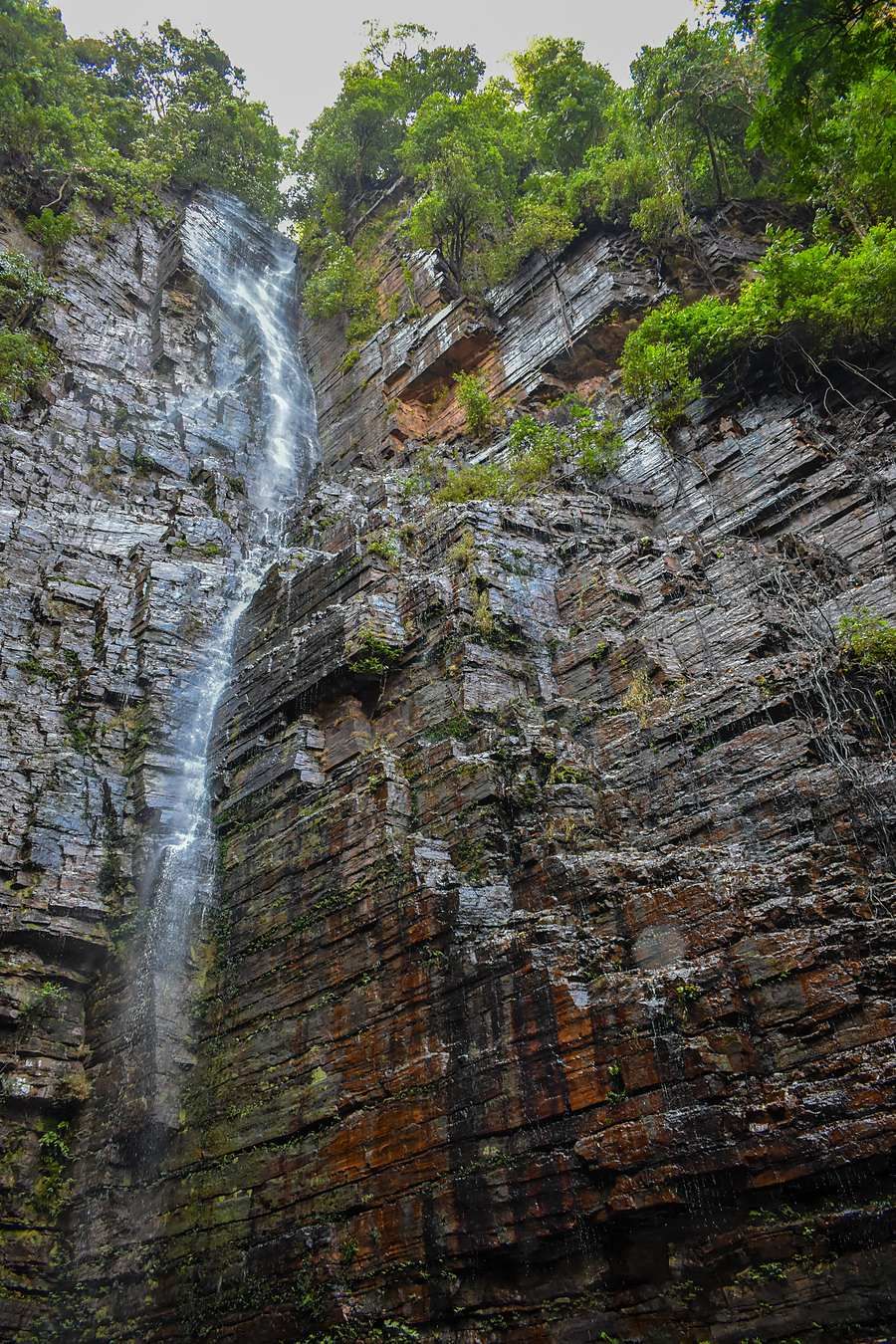
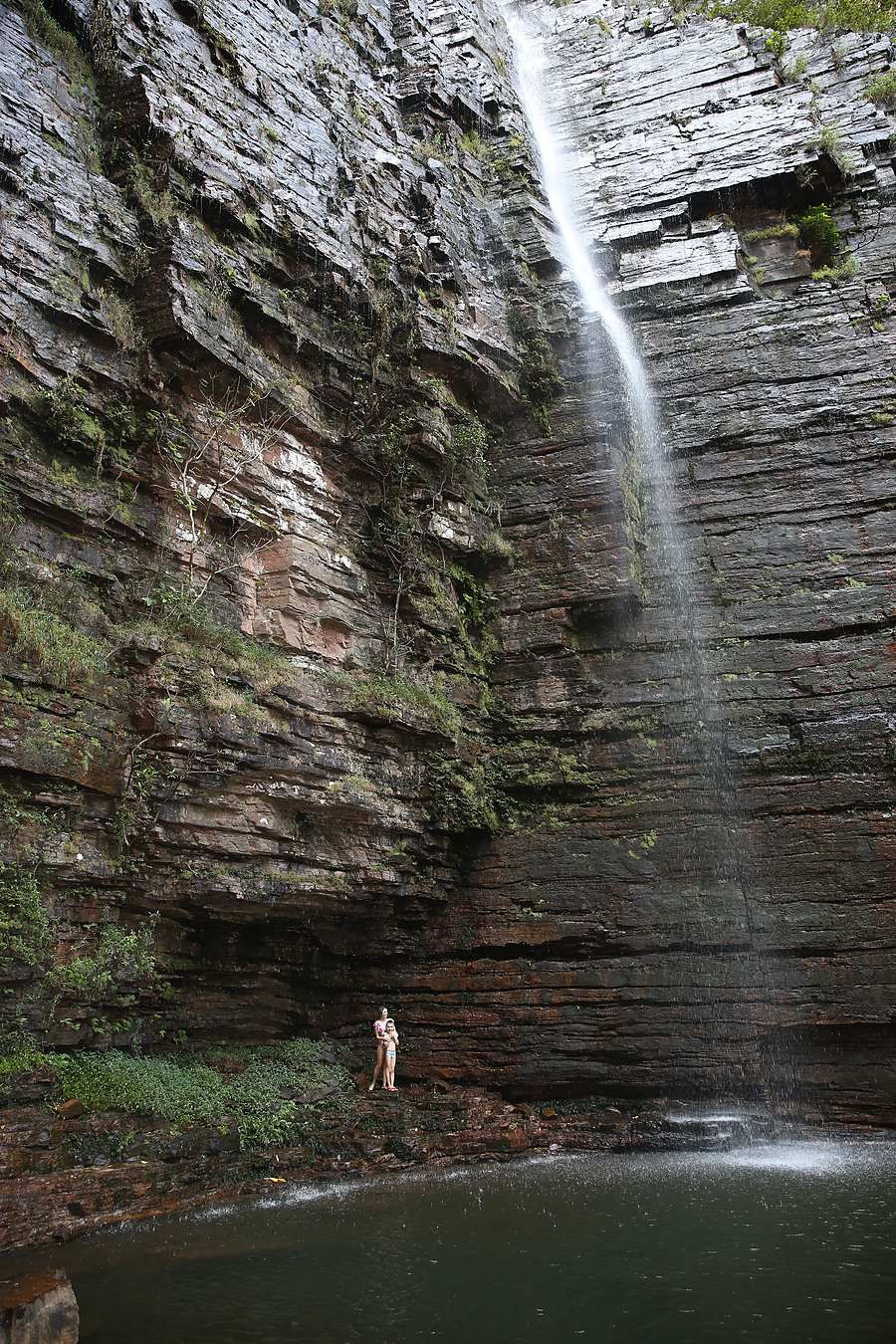
Dindéfélo Falls has to be earned twice: first by the road, which takes you right across Senegal; then by the trail, which leads you on foot into the forest. And it is precisely that double effort that protects it. Here, there is no car park at the foot of the falls and no snack bar by the pool: a sandstone cliff, a ribbon of water dropping around a hundred metres, a cold pool, and a forest guarded by the people who live here. If you come thinking of a quick photo, you will leave with much more, as long as you take your time.
At a glance
| Region | Kédougou Region, Kédougou department, Dindéfélo commune, very close to the Guinean border |
| Type | Waterfall within the Dindéfélo Community Nature Reserve, in the Fula (Peul) area of the UNESCO-listed Bassari Country (Pays Bassari) |
| Getting there from Dakar | About 700 km to Kédougou via Kaolack and Tambacounda (a long day, roughly 10 to 12 hours), then 30 to 40 km of road and track, i.e. 1 to 1½ hours |
| From the village | A forest trail along the stream, roughly half an hour to an hour’s walk depending on your pace |
| Recommended time | Half a day for the falls; two days on site to add the Dandé plateau |
| Official fees | The reserve’s community entry fee, payable on site in cash and not included in the price; visit with a local eco-guide |
| Best time to go | November–February for walking; September–November for a full waterfall |
| Related QFS activities | Guided hikes, traditional sites & villages, guided cultural tours |
Resident or visitor: one trail, two journeys
Live in Senegal? Dindéfélo Falls is one of the few good reasons to drive 700 km for a swim. Do not attempt it over a weekend: a four-day long weekend is the reasonable minimum, with a night in Tambacounda on the way there if you are driving. Make it the centrepiece of a stay in the south-east, with Kédougou as your base and Bassari Country for the hilltop villages. And come back in another season: the waterfall at the end of the rainy season (hivernage), swollen and roaring, is nothing like the thin veil of water at the end of the dry season. On QFS, you get the resident rate: up to 30% off depending on the activity.
Just passing through? The reflex is to do the return trip from Kédougou in a day: falls ticked off, back for dinner. It can be done, but you would miss what gives the place its value: the trail in the cool of the morning, before the day visitors; the climb to the plateau; the village as evening falls. Spend at least one night in Dindéfélo. Bring cash for the entry fee and good shoes, and bear in mind that you are crossing land that is lived in and protected by the people who live there.
A waterfall under village guard
What sets Dindéfélo apart from the country’s other waterfalls is not its height but its status. In 2010, the villages of the commune set up the Dindéfélo Community Nature Reserve, a locally managed protected area, with a management committee, eco-guards on patrol and eco-guides trained locally. The area covers 13,000 to 14,000 hectares of gallery forest, sandstone cliffs and wooded savannah plateaus, straddling the foothills of the Guinean Fouta-Djalon.
The principle is simple: residents carry on living, farming and grazing their herds here, but according to a zoning plan that leaves room for the forest and wildlife. Women’s groups grow vegetables and replant trees to ease the pressure on the forest; schools teach children about the reserve. This model earned the reserve the 2024 UNDP Equator Prize (United Nations Development Programme), which rewards local and indigenous initiatives to protect nature. The entry fee you pay in the village goes straight into this work: it is not a toll, it is a contribution.
The landscape is also part of a much larger whole. In 2012, UNESCO added “Bassari Country: Bassari, Fula and Bedik Cultural Landscapes” to the World Heritage List, bringing together three areas: Bassari around Salémata, Bedik around Bandafassi, and Fula around Dindéfélo. What the listing protects here is a land of herders at the foot of a plateau from which the water falls.
How many metres, exactly?
Be wary of the figures doing the rounds. Most sources give the waterfall around a hundred metres; others put it at 115 or even 120 metres. Nobody publishes a reference measurement, and the height you perceive changes with where you are standing and the flow at the time. Remember the essentials: from the edge of the pool, you have to tip your head right back to see where the water starts.
What about the chimpanzees?
The reserve is home to western chimpanzees, a critically endangered subspecies, among the last wild groups in Senegal. Several dozen individuals live in its valleys and move between Senegal and Guinea; they have been monitored for years by research teams and by the eco-guides. Let us be frank: on the way to the waterfall, you very probably will not see them. Watching them is a separate outing, at dawn, in a very small group, with an eco-guide, and it is always a chance, never a promise. Do not come for them; be delighted if they come to you.