Lompoul desert: ochre dunes, overnight camp, zircon | QFS
Accueil » iconic locations » Lompoul desert: a little Sahara best experienced at sunset

Home › Locations › Lompoul › Lompoul desert: a little Sahara best experienced at sunset

LOMPOUL

Lompoul desert: a little Sahara best experienced at sunset

Some twenty square kilometres of ochre dunes between the bush and the Atlantic: you can take in the Lompoul desert at a glance, which is exactly why you need to be there at the right time. In recent years, the zircon mine has changed part of the scenery; here is what remains, and how to experience it.

The Lompoul desert is small, and that is the first thing to accept: from the top of a dune, you can almost see where it ends. But it would be a mistake to conclude that it is not worth the journey. What makes Lompoul is not its vastness, it is the timing: the light that turns the sand red at sunset, the cold that falls all at once, the silence of the night and the first sun on the ridges. Come for those twelve hours, know that the zircon mine has transformed part of the scenery in recent years, and you will not be disappointed.

At a glance

RegionLouga Region, Kébémer department, between the town of Kébémer and Lompoul-sur-Mer, on the Grande Côte
TypeSmall cluster of ochre and orange sand dunes, a few kilometres from the Atlantic Ocean, on the edge of the Niayes area
Getting there from DakarAbout 150 to 200 km depending on your starting point; 3 to 4 hours by road along the Saint-Louis route, including the final track
Getting there from Saint-LouisOne and a half to two hours by road, including the final track
Recommended timeOne night, from sunset to sunrise; a long day if you do not have time to stay over
Official feesNo additional official fees
Best time to goDry season, November to May; coolest nights December to February
Related QFS activitiesDay trip from Lac Rose (Pink Lake) or Dakar, overnight camp under canvas from Dakar or the Petite Côte, Saint-Louis & Lompoul tours

Resident or visitor: two ways to read the same sand

Live in Senegal? Lompoul is the most otherworldly getaway you can manage in a weekend without taking a plane. You leave Dakar or the Petite Côte on Saturday, you are in the dunes for sunset, you sleep under canvas and you head home on Sunday. Choose the cool season, when you need a jumper as night falls: that is when the contrast with the city is strongest. On activities booked with QFS, you get the resident rate: up to 30% off depending on the activity, which makes it a proper outing with friends or family.

Just passing through? Do not build your trip around Lompoul: make it the stop that breaks up the road between Dakar and Saint-Louis. One night is enough. And arrive with the right expectations: you will find fine sand, ridges, a camp atmosphere and a very dark sky, not a desert stretching as far as the eye can see, nor an untouched landscape. If you only have a day, from Lac Rose or Dakar, the option exists, but you will spend more time on the road than in the dunes.

A pocket desert between the bush and the ocean

A geographical curiosity

Nothing really prepares you for Lompoul. On the road to Saint-Louis, the landscape is that of the coastal Sahel: pale sand, fields, casuarinas, small market gardens in the Niayes. Then, a few kilometres from the Atlantic, an island of ochre dunes rises up, almost bare of vegetation, its ridges towering over the plain. Sources agree on a modest area, around 18 to 20 km², and on dunes that reach several tens of metres. That is enough to give the illusion of the Sahara, and it is what made it, for years, a very popular excursion: it is often called Senegal’s “little Sahara”, or a foretaste of the Mauritanian deserts that begin further north.

The colour is everything

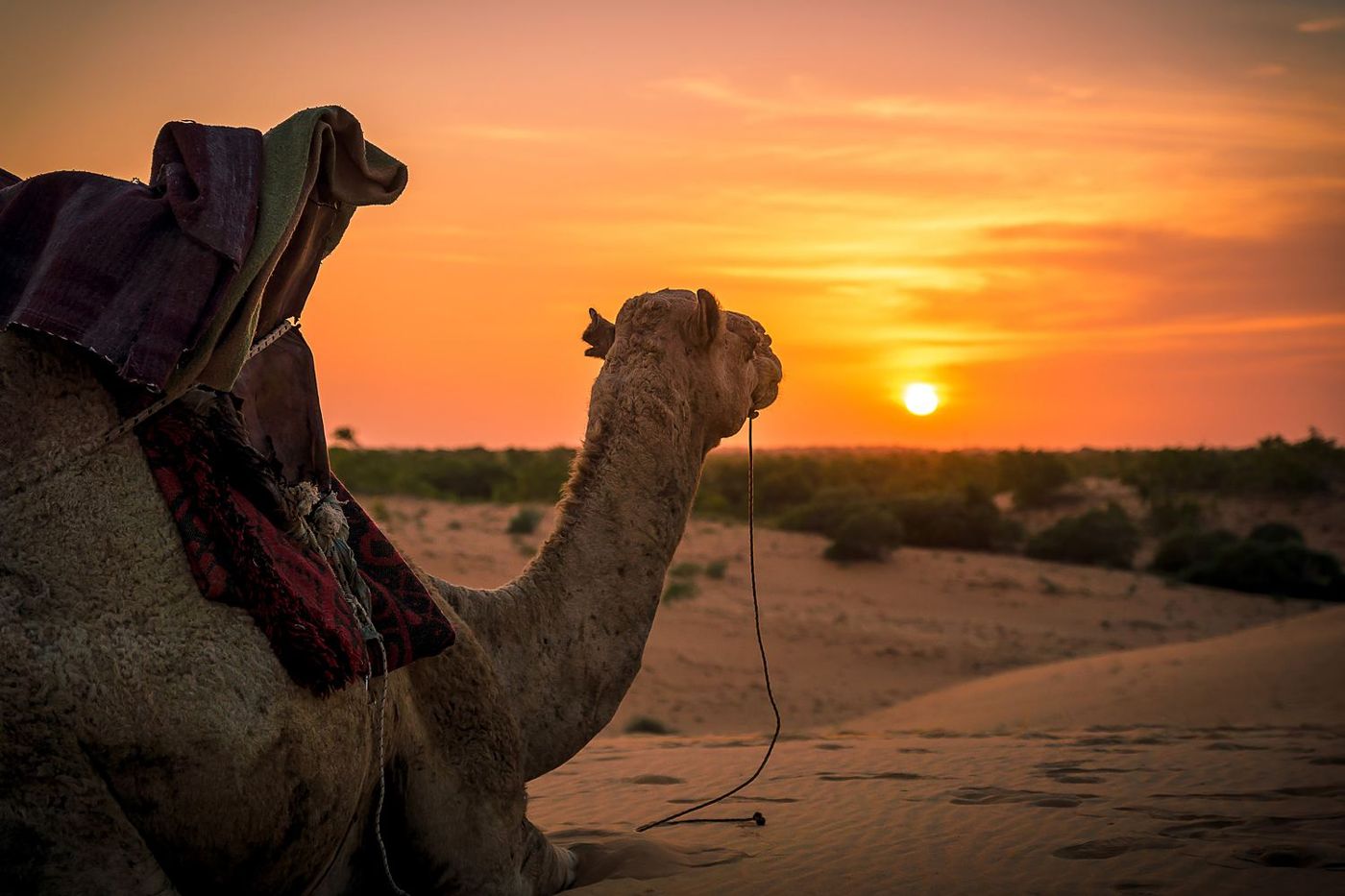
Lompoul’s sand is very fine, and its shade changes with the hour. Pale yellow, almost white, under the midday sun, it turns ochre in the late afternoon, then orange and red as the sun touches the horizon. That is why everything here revolves around sunset and sunrise. In the middle of the day, the desert is flat, crushed, without relief; at golden hour, every ripple in the sand casts a shadow, every ridge stands out, and the scenery takes on the depth it lacks at noon. The most useful advice on this page fits in one sentence: be on a ridge half an hour before sunset, and stay there until the end.

The night, the other half of the journey

Lompoul’s second surprise is the temperature. In the dry season, and especially from December to February, the nights are noticeably cooler than the heat of the day would suggest: the sand quickly gives up its warmth, the ocean wind blows, and you need a warm layer around the fire. In return, the absence of lighting nearby gives you a sky of rare density. Sunrise, the next morning, unfolds in the same silence, before the heat returns.

What has changed: the zircon mine

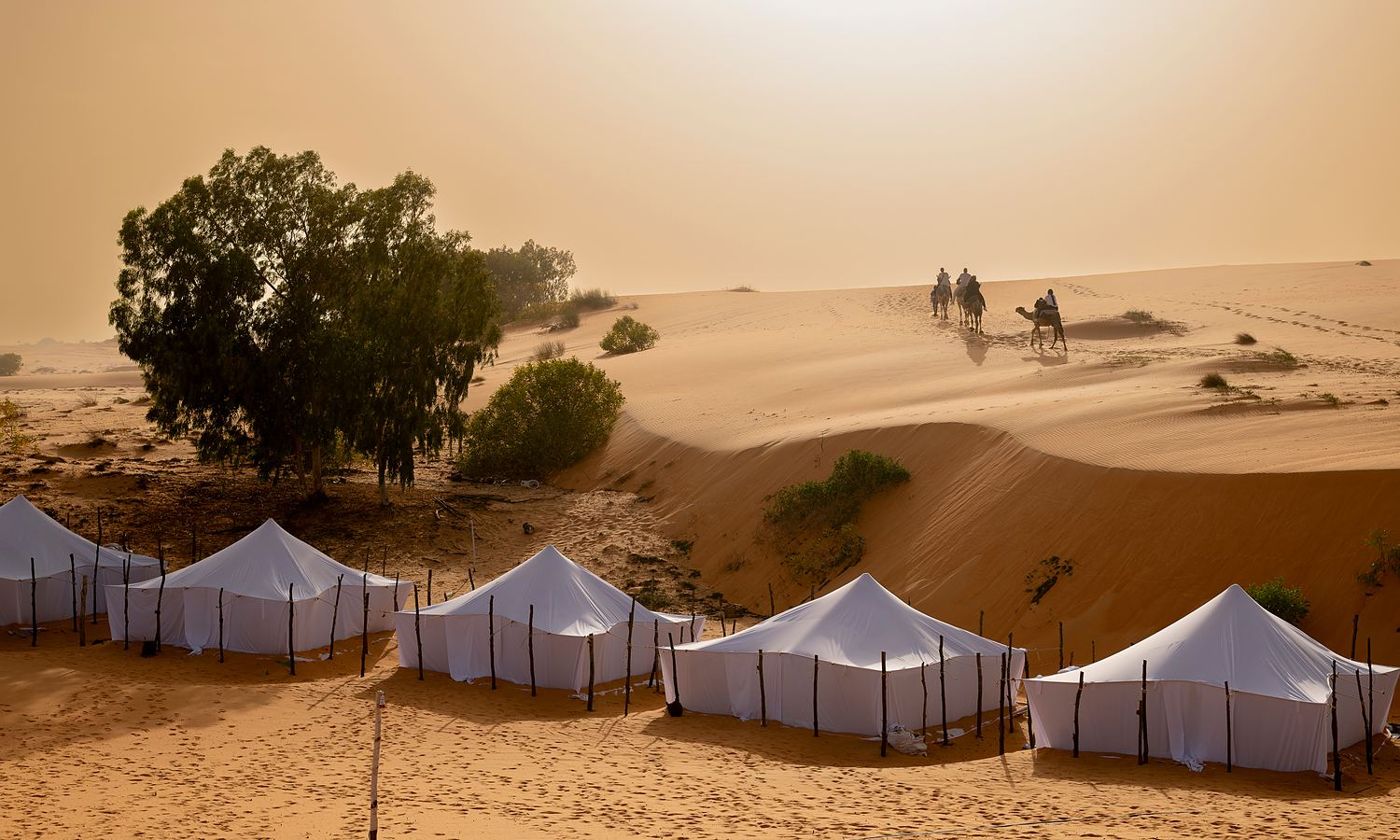
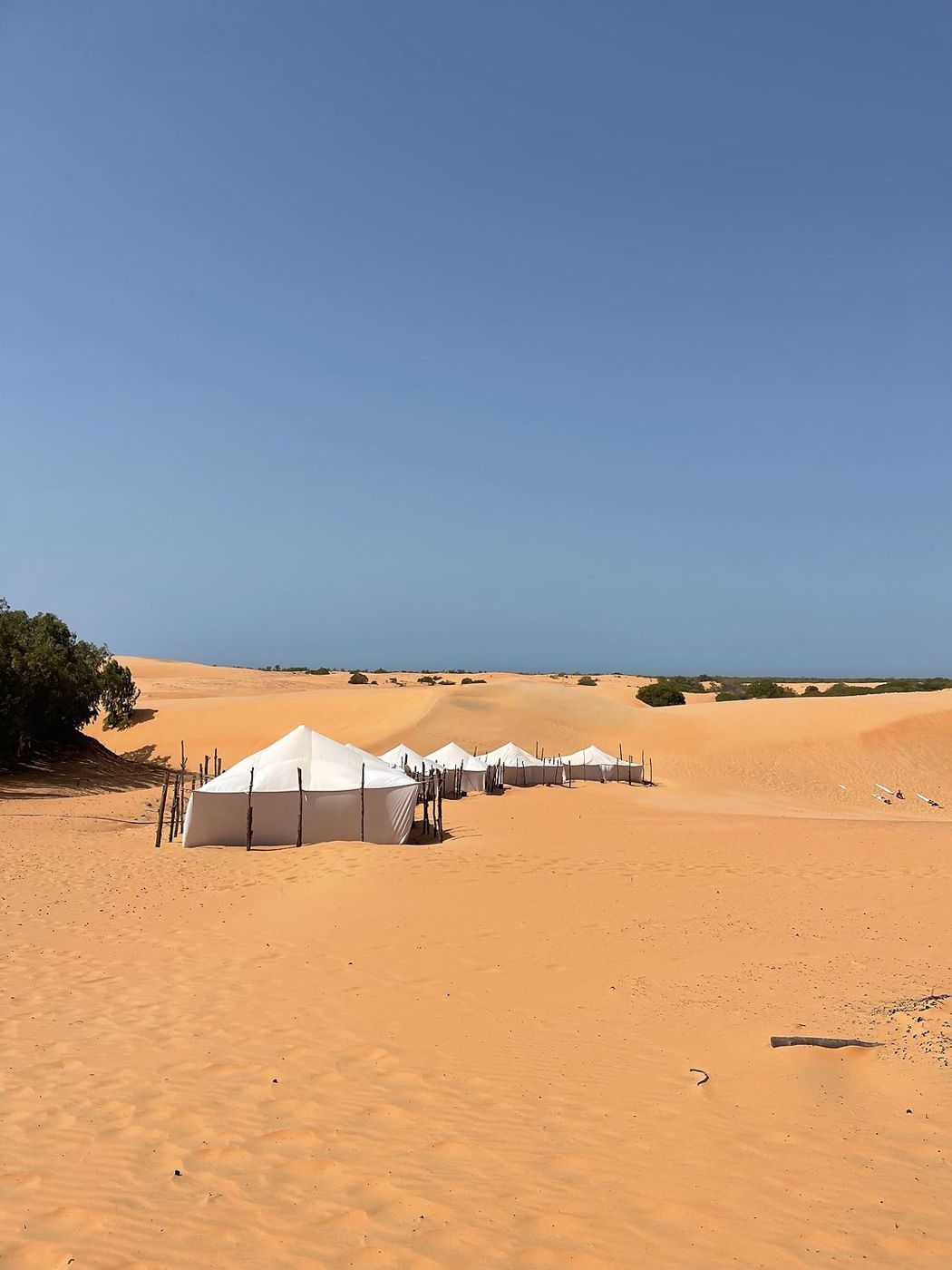
This needs saying before we send you there. The Grande Côte, which runs from Dakar to Saint-Louis, is rich in mineral sands, including zircon. Industrial mining is gradually working its way up this coast and, in recent years, it has reached part of Lompoul’s historic dunes. Camps that had been set up there for a long time had to close or move; part of the tourist activity has shifted to a purpose-built site further south, with a recreated dune and palm grove.

What this changes for you: some views now look out over reworked ground, and the Lompoul of the old photos, that untouched field of dunes where you slept far from everything, no longer exists as it was. What does not change: the ochre sand, the ridges, the cold of the night, the starry sky and the pleasure of walking barefoot at sunrise.

For the people of the neighbouring communes, the advance of the mine remains a sensitive subject, caught between jobs, farmland, water in the Niayes and tourism. If it comes up while you are there, listen more than you comment: this debate belongs first and foremost to those who live there.

  • Wildlife reserves & parks

    Guided half day at Djoudj National Bird Park

    Saint-Louis · Half-day (5h)


    From66 000 CFA
    Resident price62 700 CFA−5 %
  • Adventure & outdoors

    Guided excursions in Saint-Louis

    Saint-Louis · 1h30 to several days depending on the option


    From13 200 CFA
    Resident price12 540 CFA−5 %
  • Wildlife reserves & parks

    Djoudj day trip from Saint-Louis: pirogue and horse cart

    Saint-Louis · 1h30, Full day


    From4 400 CFA
    Resident price3 740 CFA−15 %

Key facts & figures

FactFigure
Administrative areaLouga Region, Kébémer department
AreaAbout 18 to 20 km², depending on the source
Height of the dunesSeveral tens of metres for the highest
Colour of the sandOchre to orange, very fine, almost bare of vegetation
Distance to the oceanA few kilometres, as far as Lompoul-sur-Mer and the Grande Côte
Distance from DakarAbout 150 to 200 km depending on your starting point; 3 to 4 hours by road
Position on the northern routeRoughly halfway between Dakar and Saint-Louis
ClimateDry season November to May; cool nights in the dry season, especially December to February; rains July to October
Zircon miningHas reached part of the historic dunes in recent years; camps have had to move

Getting there & official fees

Lompoul is reached via the main Saint-Louis road, through Thiès and then Kébémer. The last few kilometres are on a sandy track that ordinary cars struggle with: the final transfer to the dunes is usually made in an off-road vehicle. From Dakar, allow 3 to 4 hours depending on traffic, your starting point and the track; from Saint-Louis, one and a half to two hours. Leave by late morning at the latest if you want to be in the sand before sunset.

Public transport serves Kébémer, but not the dunes: the simplest solution is an activity that includes transport, or a private transfer with a driver. Bring cash, as cash machines are rare once you leave the main road, and the phone signal can weaken in the hollows between the dunes.

No official entry fee is charged for the dunes: there are no additional official fees. You only pay for the activity you choose, whose content is detailed on each listing; on the day trip from Lac Rose, site entry is included.

What to see

  • The ridges at sunset: the main show, which costs nothing more than being there at the right moment. Choose a west-facing ridge, sit down and watch the sand change colour.
  • Sunrise: less popular than sunset, and often more beautiful, with the cool air, the low light and the night’s tracks still sharp in the sand.
  • The night sky: far from the cities, the Milky Way is visible to the naked eye on moonless nights. Step a few paces away from the fire to let your eyes adjust.
  • Tracks in the sand: early in the morning, insects and small sand creatures leave prints that the wind erases during the day. A good moment for children.
  • Lompoul-sur-Mer: a few kilometres to the west, a fishing village on the Grande Côte, with its pirogues pulled up on the sand, its casuarinas and the fishing boats coming in at the end of the day. Leave your swimsuit in your bag: swimming there is dangerous.
  • The Niayes gardens: along the road, small market-garden plots between the dunes are a reminder that this coastal strip feeds much of the country with vegetables.

Nearby

Lompoul is presented from the activities angle on our Lompoul page, and set in its region on our Louga Region page. To the north, Saint-Louis and Saint-Louis Region open onto the river: the Djoudj National Bird Sanctuary, the Langue de Barbarie, Guembeul Reserve and, further east, Lac de Guiers. To the south, Thiès Region lines the way back to Dakar. And if the dunes have given you a taste for sand without such a long drive, Lac Rose (see also our Lac Rose page) offers a close-to-home version, on the capital’s doorstep.

  • Adventure & outdoors

    Guided excursions in Saint-Louis

    Saint-Louis · 1h30 to several days depending on the option


    From13 200 CFA
    Resident price12 540 CFA−5 %
  • Excursions & adventures

    4×4 excursion from Saint-Louis: bush and villages

    Saint-Louis · Half-day (~4h)


    From38 500 CFA
    Resident price36 575 CFA−5 %
  • Water sports & sea activities

    Electric scooter ride in Saint-Louis

    Saint-Louis · 30 min – 1h


    From1 650 CFA
    Resident price1 485 CFA−10 %

The right time

By season. November to February is the best time: mild days, cool or even cold nights under canvas. From March to May, it is still dry, but the heat builds in the afternoon and the wind can whip up the sand. From July to October, the rainy season (hivernage) brings heavy heat, storms and slower tracks: only for those who cannot choose their dates. The end-of-year holidays draw big crowds: if you are looking for peace and quiet, avoid Christmas and New Year’s Eve.

By time of day. Arrive in the afternoon, never at midday. The flat light and the heat of the middle of the day are the worst moment to discover the dunes.

Sunset. Climb up half an hour before the sun touches the horizon, facing west towards the ocean. Silhouettes on the ridges, long shadows and sand turning from ochre to red: it is the photo everyone comes for, and it does not disappoint.

Practical tips

  • Against the sand: a desert turban or scarf, sunglasses, and protection for your phone and camera when the wind gets up.
  • For the night: a warm layer, even in the dry season, and a head torch to move between the tents.
  • On your feet: sandals or shoes that are easy to empty; barefoot, the sand burns in the middle of the day.
  • Sun and water: sun cream, a hat and plenty of water: water remains a precious resource on site.
  • Respect the place: take your rubbish away with you, carve nothing into the sand of the fragile ridges, and ask before photographing people from the neighbouring villages.
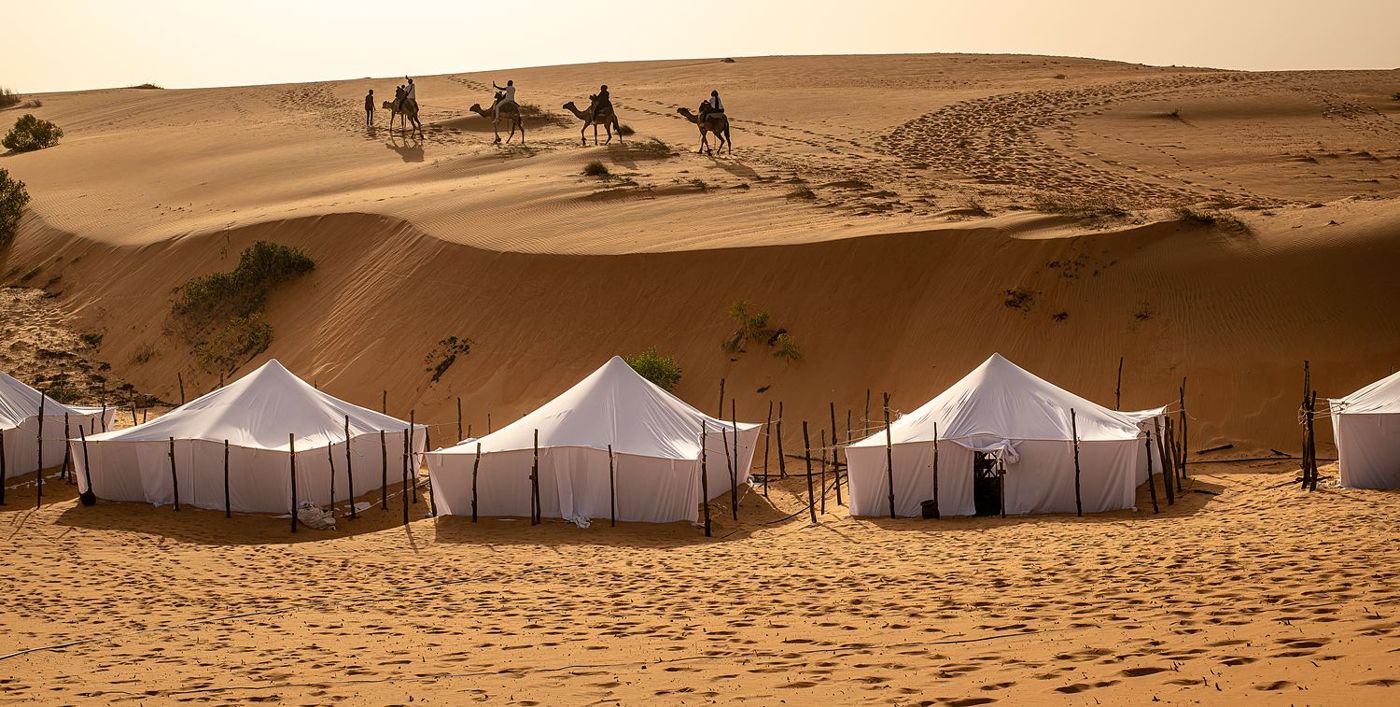
  • The animals: the camel is led on foot by its camel driver; follow their instructions for getting on and off.
  • The ocean: at Lompoul-sur-Mer and all along the Grande Côte, powerful waves and currents make swimming dangerous.

Book an activity here with QFS

The desert can be discovered through three types of package, all of them accompanied. The day trip to Lompoul leaves early in the morning, either from Lac Rose, with transport, guide, meal and site entry included, or from Dakar (Cicès or Sédima), with a camel ride and a quad bike ride included, but not lunch. The overnight camp, one night under canvas, leaves from Dakar, with hotel pick-up, or from the Petite Côte, with pick-up from your home: transport, the night and half board are included, drinks are extra, and the package from Dakar adds the camel and the quad bike. Both of these packages are in the adventure & outdoors section. The Saint-Louis & Lompoul tours, over two days and one night or three days and two nights, combine the island of Saint-Louis with a night in the dunes; pick-up is included from the Petite Côte, with a transport supplement from Dakar, and the quad bike is offered as an option, paid on site. They are listed under guided cultural tours.

In Lompoul, the 4×4, the quad bike and the camel are never booked on their own: they are part of these packages. If what you are after is a quad & buggy outing, a 4×4 (safari & dunes) trip or one of the horse & camel rides for its own sake, look at Lac Rose instead. To come from Saint-Louis under your own steam, see intercity transfers.

You pay 20% to secure your booking (the booking fee), and the balance is paid on site, on the day. There are no additional official fees for the desert. If you live in Senegal, you get the resident rate: up to 30% off depending on the activity (the exact rate is shown on each listing).

Frequently asked questions

Does the Lompoul desert still exist?
Yes, but transformed. In recent years, zircon mining has reached part of the historic dunes and camps have had to move further south. The ochre sand, the ridges and the desert nights remain, but not the untouched scenery of the old photos.
Where is the Lompoul desert?
In Kébémer department, Louga Region, between the town of Kébémer and Lompoul-sur-Mer, a few kilometres from the Atlantic. It lies roughly halfway between Dakar and Saint-Louis.
How long does it take from Dakar?
Allow 3 to 4 hours by road for about 150 to 200 km, including the final track. From Saint-Louis, one and a half to two hours.
Is it cold at night in the Lompoul desert?
The nights are cool in the dry season, especially from December to February, while the days stay mild. Bring a warm layer for the evening and for sunrise.
Can you do a quad bike or camel ride on its own in Lompoul?
No, not with QFS: the camel and the quad bike are included in the day trip and the overnight camp from Dakar, and the quad bike is offered as an option on the Saint-Louis & Lompoul tours. For a quad bike or camel ride on its own, Lac Rose is the place to go.
Do you have to pay an entry fee?
No, there are no additional official fees for the desert. You only pay for the activity you choose; on the day trip from Lac Rose, site entry is included.

Read also