Senegal & the horse: from the kings of Cayor to the Thiès racecourse
For centuries, the horse was an animal of power in Senegal. The Wolof kingdoms, Jolof and later Cayor and Baol, brought it in from the north, across the desert, and paid dearly for it, often in captives. When Portuguese ships began to sail along the coast, in the 1440s, horses were already among the things the rulers sought to buy from them. A horse spoke of the rank of the man who rode it.
The most famous of these horsemen is Lat Dior Ngoné Latyr Diop, damel (king) of Cayor. He refused the railway that France wanted to lay between Dakar and Saint-Louis across his kingdom, and he fell at Dékheulé in October 1886, with his last loyal followers. His horse, Malaw, entered the national memory almost on a par with him: at the entrance to the Cices, in Dakar, a bronze equestrian statue shows them together.
This past has not been shut away in a museum. Go to Thiès on a race Sunday: at the Ndiaw Macodou Diop racecourse, the stables line up their horses, jockeys in silks battle for the finishing post, and the crowd bets, comments and cheers its favourite all the way to the line. The highlight of the season, the Grand Prix du Chef de l’État (Head of State’s Grand Prix), is run there every year.
The camel tells of another geography. For a long time it was a familiar sight in the Sahelian north, the pack animal of herders, until the roads made it less necessary. Today you mostly find it on the coast, in the dunes of Lac Rose or on the beach at Saly, where it is used for rides.
Formats: in the saddle, in a carriage or on a camel
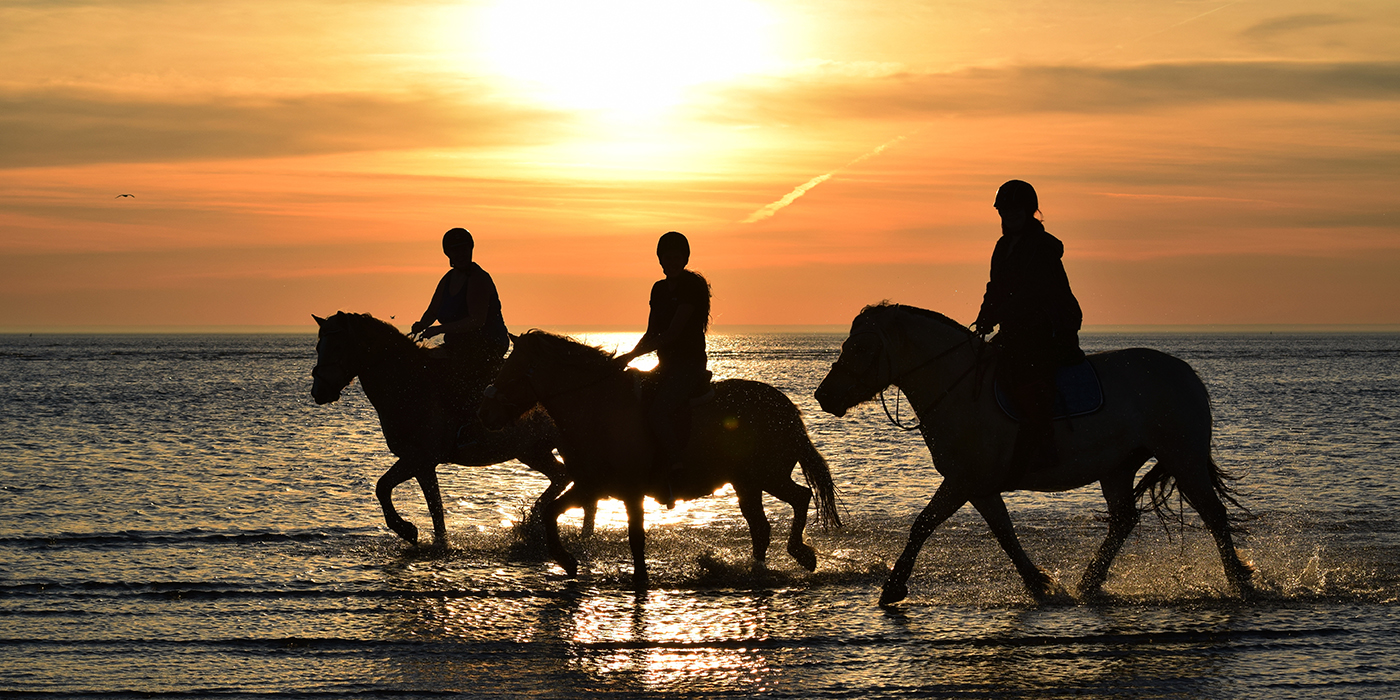
- Horse riding on the beach or in the dunes: at Lac Rose, Saly or Toubab Dialaw, from a few minutes for a first encounter to a full day for confident riders. At a walk for beginners, at a trot or canter for those who know how.
- Horse riding in the Sine-Saloum: one to two hours in the saddle among the bush, the baobabs and the inlets of the sea.
- The town tour by carriage: in Saint-Louis, an hour and a half to two hours through the streets of the listed island.
- The carriage through villages and lagoons: in Saly and Mbour, at the Somone, at Pointe Sarène or on the island of Mar Lodj, from an hour to a full day, between beach, fishing neighbourhoods and sandy tracks.
- The camel ride: at Lac Rose, from a simple loop of a few minutes to half a day in the dunes; in Saly, about an hour. The animal is always led on foot by its handler.
Where to ride a horse or a camel in Senegal
- Lac Rose: the only place where you can choose between horse and camel, on the ridge of dunes that separates the lake from the ocean. The site has free access, with no entrance fee. The colour varies with the season (see the Lac Rose page).
- The Petite Côte: this is where you will find the most choice. In Saly, horse, camel and carriage; at the Somone, the carriage to the edge of the lagoon; at Pointe Sarène, further south, a three-hour outing on a quieter stretch of coast. At Toubab Dialaw, at the gateway to the Petite Côte, you ride at the foot of the ochre cliffs.
- The Sine-Saloum: two moods. In the saddle in the bush of the delta, or by carriage on Mar Lodj, a car-free island where people get around on foot or by cart among the baobabs, a quarter of an hour to half an hour by pirogue from Ndangane (see also the Mar Lodj page).
- Saint-Louis: the carriage is a classic here, to get your bearings on the island before coming back on foot. Allow four to five hours by road from Dakar.
- Lompoul: the setting everyone instantly associates with the camel. But in recent years, the zircon mine has taken over part of the historic dunes, and some camps have closed or moved further south. No ride in this category is offered there: the Lompoul camel is booked with the desert day trip or the bivouac from Dakar, in adventure & outdoors, or with the Saint-Louis & Lompoul tours, in the guided cultural tours. Read the Lompoul desert page before you go.
When to go
The dry season, from November to May, is the best: passable tracks and bearable heat, for you as for the animal. During the rainy season (hivernage), especially from July to October, the rain soaks the bush paths; the beach remains rideable, but early in the day.
Whatever the season, the time of day matters more than the month. Ride early in the morning or in the late afternoon, never in the middle of the day. On the beach, low tide leaves a strip of firm sand where the horse moves easily: check the tide times before booking a slot. And if you are in Thiès on a Sunday during the racing season, make the detour to the racecourse: it is the best lesson in equestrian history the country has to offer.
Good to know & budget
No technical gear needed: long trousers (the rubbing of stirrups or saddle on bare legs quickly gets uncomfortable), closed shoes, a hat, water and sun cream. Ask for a helmet for children and beginners. On a camel, watch out for the two tricky moments: when the animal stands up and when it kneels down, it pitches forwards and backwards; hold on tight and follow the handler’s instructions.
Take a look at the animal too: neither emaciated nor injured, tack that does not rub, no work under the midday sun. If something bothers you, you are entitled to cut the ride short.
Watch the price unit. Most rides are shown per person. But a carriage is often hired as a whole: some listings show a price per group, with a number of seats. Read the wording before comparing.
The price shown on each listing is the price of the activity. You pay 20% to secure your booking (the booking fee), and the balance is paid on site, on the day of the ride. If you live in Senegal, you get the resident rate: up to 30% off, depending on the outing (the exact rate is shown on each listing). On the beach, at Lac Rose, in the streets of Saint-Louis or on Mar Lodj, there are no additional official fees.
Who is it for?
Families can take the whole tribe in a carriage, and a camel at a walk can be shared with a five-year-old. Beginners have short, accompanied rides; experienced riders will go for the long outings on the beach or in the Saloum bush. Check the minimum age and the level required on the listing.
If you are a resident, this category is made for the Saturdays when Dakar gets too noisy. An hour on horseback at Lac Rose at dawn, or at Toubab Dialaw at the foot of the cliff, and you are home for lunch; on a weekend in the Saloum, the carriage takes you round Mar Lodj without any effort. If you are a visitor, do not settle for five minutes on a camel for the photo. Save a real horse ride, at sunset, on Saly beach; in Saint-Louis, start with the carriage: the driver often knows more than the guides.
On 12 December 2024, in Thiès, President Bassirou Diomaye Faye inaugurated a monument to the memory of Lat Dior. Thiès, in the land of the former Cayor, is also the town where the country’s best horses race today. When you ride along a beach on the Petite Côte, at a walk, with the sea on your right, you will know you are not the first to love this country from the height of a saddle.
Frequently asked questions
Do you need to know how to ride?
Not for short rides at a walk, which are accompanied, nor for the carriage or the camel. Trotting, cantering and outings of several hours call for some confidence in the saddle: the level required is shown on each listing.
Is the price per person or per carriage?
It depends on the outing. Most rides are shown per person, but some carriages are priced per group, with a number of seats. This is stated on each listing: check it before comparing.
Are camel rides suitable for children?
Yes, it’s actually one of the gentlest outings: the animal moves at a walk, led on foot by its handler, and the ride can last just a few minutes. Hold the child firmly when the camel stands up and kneels down.
Can you ride a camel at Lompoul?
Yes, but not in this category: the camel is included in the Lompoul desert day trip and in the bivouac when they leave from Dakar, and features in the programme of the Saint-Louis & Lompoul tours depending on the package. The scenery has changed since the zircon mine took over part of the dunes in recent years. Here, camel rides take place at Lac Rose and in Saly.
How do you book?
You pay 20% to secure your booking (the booking fee), and the balance is paid on site, on the day of the ride. No official fees are added, and residents of Senegal get the resident rate: up to 30% off (the exact rate is shown on each listing).