Senegal & protected areas: four ways to protect an animal
At the top are the national parks, run by the state. The largest, Niokolo-Koba National Park, covers more than 900,000 hectares of savannah and gallery forest along the Gambia River, in the south-east. A UNESCO World Heritage Site since 1981, it is home to the Derby eland, chimpanzees, lions and leopards. In 2007, poaching and human pressure had put it on the List of World Heritage in Danger. In July 2024, UNESCO removed it from that list: the park remains a World Heritage Site, only its “in danger” status has been lifted. It is one of the best pieces of news in West African conservation in recent years.
The north has its own parks: the Djoudj National Bird Sanctuary, created in 1971 and a World Heritage Site since 1981, the winter refuge of migratory birds in the Senegal River delta, and Langue de Barbarie National Park, a national park since 1976, on the sand spit that separates the river from the ocean. In the centre-west, the Saloum Delta, a World Heritage Site since 2011, combines mangroves, bolongs (tidal creeks) and dry forest.
The second family is the special reserves, designed for a specific mission. The Guembeul Reserve, a special wildlife reserve created in 1983 near Saint-Louis, serves as a waiting room for Sahelian species the country had lost: dama gazelles, oryx and African spurred tortoises, raised behind the shelter of a fence before being released elsewhere.
The third family is the community reserves, born of local people’s initiative. At the Somone, the lagoon has been protected since 1999; at Popenguine, the 1986 reserve owes a great deal to a women’s collective; at Palmarin, the community reserve dates from 2001. In Dakar itself, the Grande Niaye de Pikine, at the Technopole, became an urban nature reserve in 2019.
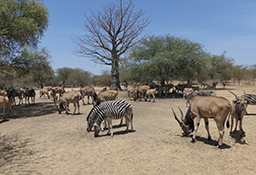
The last family is the private reserves. Bandia, on the Petite Côte, and Fathala, south of the Saloum, have been restocked with giraffes, rhinos, zebras and buffalo. They also play a serious role for the Derby eland, the largest antelope in the world: animals captured in Niokolo-Koba breed there, as part of a programme monitored by scientists.
Formats: what you can book
- Djoudj from Saint-Louis: a half day with a guide or a full day, with the pirogue trip to the pelican colonies as the highlight.
- The Guembeul Reserve on foot: a guided visit of an hour and a half to two hours, to meet the gazelles, oryx, African spurred tortoises and the birds of the lagoon.
- The Bandia Reserve: on a safari on its own, or combined in a day with the Somone lagoon, Lac Rose, or both, with a 4×4 version leaving from Dakar.
- Bandia and the lions: a half day or a full day, the reserve and then a neighbouring site where you watch lions from a secure vehicle.
- Fathala, safari and lion encounter: a day in the Fathala forest, with the approach to the lions supervised by the keepers.
- Stays: three days around Bandia leaving from your accommodation, or a three-day bivouac in the Saloum Delta with the walk with the lions.
Niokolo-Koba is booked in the safari section; outings focused on birds, on the Langue de Barbarie or in the Saloum, are under birdwatching.
Where to visit a reserve in Senegal
- The north, around Saint-Louis. The country’s best concentration of protected areas: Djoudj, some sixty kilometres to the north, the Guembeul Reserve, about ten kilometres to the south, and the Langue de Barbarie, reached by pirogue from Gandiol. Two days in Saint-Louis are enough to do all three.
- The Petite Côte. Bandia is about half an hour from Saly, the Somone and its lagoon right next door, Popenguine and its cliffs a little further north. It is the easiest area for a day trip from Dakar.
- The Sine-Saloum. South of the delta, near Toubacouta and the border with the Gambia, Fathala offers a forest safari with a wilder feel than Bandia. On the ocean side, Palmarin and its community reserve, between lagoons and tann (salt flats). Allow at least one night there.
- The south-east, Kédougou. Niokolo-Koba is a real journey, to be done over several days, ideally together with the villages of Bassari Country (Pays Bassari) and Dindéfélo Falls.
- Dakar. Madeleine Islands National Park, offshore, is visited on a supervised outing and comes under island excursions.
When to go
The dry season, from November to June, is the right time. The grass dries out, the vegetation thins, animals gather around water points and the tracks stay passable. At Djoudj, the calendar is even clearer: the park opens in November, with a peak of migratory birds from December to February, and closes during the rainy season (hivernage). For Niokolo-Koba, aim for November to February: from March to May, the south-east becomes the hottest region in the country.
The hivernage, from July to October, makes the bush superb but dense, and some tracks muddy. Bandia and Guembeul can still be visited, with time to spare on the journey; for Fathala, the dry season remains preferable. Whatever the season, the time of day matters more than the month: animals move in the cool, at opening time and in the late afternoon. One outing at dawn is worth two at midday.
Good to know & budget
In a protected area, you follow the rules of the place, no negotiation. You only get out of the vehicle where the guide allows it, you do not feed the animals, you keep your distance and your voice down. In the national parks and at Guembeul, visits are made with a guide or an eco-guide. Bring a hat, water, sun cream, neutral-coloured clothing, binoculars for the birds and cash in small notes.
An honest word about the lions: those you approach near Bandia or at Fathala are animals used to humans, in fenced areas. The experience is powerful, but this is not wildlife in the wild. Senegal’s free-roaming lions live in Niokolo-Koba, where seeing them remains a matter of luck.
On Que Faire Sénégal, the price shown is the price of the service, per person in this section. You pay 20% to secure your booking (the booking fee). The balance is paid on site, on the day. If you live in Senegal, you get the resident rate: up to 30% off (the exact rate is shown on each listing).
As for official fees, entry to the national parks and the public or community reserves, such as Djoudj, Guembeul, the Langue de Barbarie, the Saloum or Palmarin, is payable on site and not included in the price, sometimes with a charge for the vehicle. Bandia and Fathala are private sites, with no public entrance fee: depending on the listing, entry is included or paid on site, and each listing gives the details.
Who is it for?
Families will find short visits at Bandia and Guembeul, with no big cats at the former and on foot at the latter. Photographers and bird lovers will aim for Djoudj at dawn and the Fathala forest. Travellers on a longer trip will keep several days for Niokolo-Koba. The walk with the lions is for older children and adults, with age requirements set by the supervising team and shown on the listing.
If you live in Senegal, this section offers plenty to vary your weekends throughout the dry season: Bandia and the Somone as a round trip from Dakar, a long weekend in Saint-Louis to take in Djoudj and Guembeul one after the other, the Saloum for a bank-holiday weekend. The resident rate makes a real difference here. If you are passing through, do not rush: choose one protected area per stop, Bandia from Saly, Djoudj from Saint-Louis, Fathala from the Saloum, and let the wildlife decide the rest.
The dama gazelles grazing behind the Guembeul fence today have a homecoming story. The species had disappeared from Senegal; from 1984, Spain donated captive-born animals, soon joined by oryx from Israel. In the same reserve, African spurred tortoises were raised and then transferred to the Ferlo. Guembeul is no stage set: it is a relay between a Sahel that emptied and the one people are trying to repopulate.
Frequently asked questions
How is this different from the safari and animal parks sections?
Here, you visit the protected areas themselves, national parks and reserves, on foot, by pirogue or by vehicle. Safari focuses on big game by 4×4, Niokolo-Koba included; the animal parks section brings together short, easy family outings.
Which reserve should I choose for a first visit near Dakar?
Bandia, on the Petite Côte, about half an hour from Saly: giraffes, rhinos, zebras and buffalo can be seen from a vehicle, on its own or combined with the Somone and Lac Rose in a day.
Is Niokolo-Koba still in danger?
No. A World Heritage Site since 1981 and placed on the List of World Heritage in Danger in 2007, it was removed from that list by UNESCO in July 2024. It remains a World Heritage Site.
When should I visit Djoudj?
In the dry season: the park opens in November and migratory birds are most numerous from December to February. It closes during the rainy season.
Are entrance fees included in the price?
For the national parks and the public or community reserves, official fees are payable on site and not included in the price. Bandia and Fathala are private: entry is included or paid on site depending on the listing, which says so.
How do I book and how much do I pay in advance?
You pay 20% to secure your booking (the booking fee), and the balance is paid on site, on the day. Residents of Senegal get the resident rate: up to 30% off (the exact rate is shown on each listing).