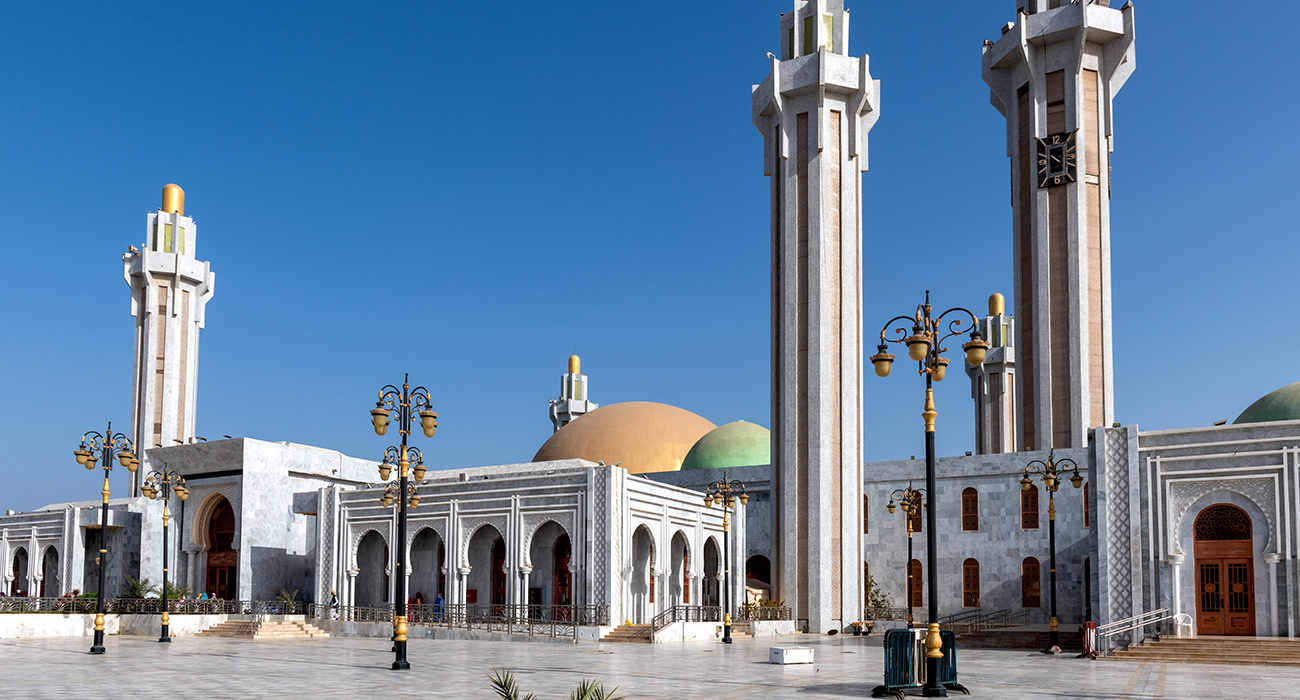
The Great Mosque of Dakar is not “visited” like a museum: it is first and foremost a place of prayer, and only by accepting that will you truly see it. You will discover it from allée Pape Gueye Fall, its 67-metre minaret standing between the Plateau and the Médina, with its arcades and decoration brought from Morocco. But behind the postcard lie three stories few visitors know: Lebou land, a friendship between two countries sealed one day in March 1964, and a prayer that today brings the nation together. Take the time to hear them before you raise your camera.
At a glance
| Region | Dakar Region, Dakar department; on the edge of the Plateau and the Médina, allée Pape Gueye Fall |
| Type | Active mosque, opened in 1964, in the Arab-Andalusian style of Moroccan inspiration |
| Getting there | By taxi from any part of Dakar (“Grande Mosquée” is enough for the driver); on foot from the Plateau; the TER (Regional Express Train) from Blaise Diagne International Airport (AIBD) to Dakar station, then a few minutes by taxi |
| Recommended time | 20 to 45 minutes around the outside; half a day if you pair it with the Médina and Tilène market |
| Official fees | No published official entry charge: it is a place of worship, not a ticketed site |
| Best time to go | All year round, outside prayer times; as a visitor, avoid Friday midday and religious festival days |
| Related QFS activities | Guided cultural tours of Dakar and the Médina, local workshops |
Resident or visitor: two ways of looking at the same minaret
If you live in Senegal, the Great Mosque is so much part of your landscape that you no longer see it. You may have come to pray here on a Friday, or seen it on television on the days of Tabaski (Eid al-Adha) and Korité (Eid al-Fitr), when the head of state attends prayers here. Come back on a weekday morning, on foot, setting off from the Plateau: you will read this building you think you know quite differently. And if friends or family from abroad come to visit, you are the one who can open the right door for them: the door of respect, of explanation, and of the right moment.
If you are passing through, do not try to “tick off” the mosque between two taxis. Come in modest clothing, outside prayer times, and consider that the exterior, the esplanade and the view of the minaret are already the visit. Entering the prayer hall is not an automatic right for a non-Muslim: the request is made on site, to those in charge of the mosque, and their answer is final. With a guide who knows the neighbourhood, the process becomes simple and the history comes fully to life.
One minaret, three stories
Lebou land
Before the mosque, this was the site of an old cemetery of the Lebou community, the first inhabitants of the Cap-Vert peninsula. The bond has never been broken: since 1964, the successive imams of the Great Mosque have come from the Lebou community, which still claims a central role in their appointment.
A building of many hands
It was the Senegal of the first years of independence that saw the construction through to completion. Funding brought together Morocco and Senegalese contributions, both public and private; the role of the Sharifian kingdom was decisive, from the plans to the decoration.
A friendship signed in 1964
On 27 March 1964, the mosque was inaugurated by King Hassan II of Morocco and President Léopold Sédar Senghor, in the presence of many religious dignitaries. The plans were drawn up by French and Moroccan architects, in the spirit of the Arab-Andalusian architecture so dear to Morocco; the interior decoration was entrusted to Moroccan craftsmen. Sixty years later, in 2024, the anniversary of the inauguration was celebrated as a symbol of the spiritual ties between Senegal and Morocco.
A prayer that brings the nation together
Today, the Great Mosque is also where the head of state attends prayers on the major festivals, such as Tabaski, before addressing a message to the nation. Our take: look at this minaret as a document. It speaks at once of the land of the Lebou, the diplomacy of the early years of independence and the daily faith of thousands of Dakar residents. Few buildings in the city say as much.
Key facts & figures
| Fact | Figure | Note |
|---|
| Inauguration | 27 March 1964 | by Hassan II and Léopold Sédar Senghor |
| Height of the minaret | 67 m | a landmark visible from afar in central Dakar |
| Design | French and Moroccan architects | interior decoration by Moroccan craftsmen |
| Style | Arab-Andalusian, of Moroccan inspiration | arcades, inner courtyard, ceramic decoration |
| Address | allée Pape Gueye Fall | between the Plateau and the Médina |
| Site | former Lebou cemetery | ongoing bond with the Lebou community |
| Islamic Institute | teaching and library | within the mosque grounds |
| 60th anniversary | 2024 | celebrated by Senegal and Morocco |
Getting there & official fees
The mosque stands on allée Pape Gueye Fall, where the administrative Plateau gives way to the working-class Médina. From the Plateau, allow about 20 minutes’ walk north, or a few minutes by taxi: simply say “Grande Mosquée”, every driver knows it, and agree the fare before you get in. From AIBD, the TER drops you at Dakar station, from where a short taxi ride is enough. From the Almadies or Ngor, allow 30 minutes to over an hour depending on traffic.
Official fees: no official entry charge is published. The Great Mosque is a place of worship, not a ticketed site. If someone near the mosque offers you an “entry” or a paid “visit” on the spot, stay polite and cautious; a donation towards upkeep, if suggested by those in charge of the mosque, remains entirely voluntary.
Times: the mosque lives to the rhythm of the five daily prayers, and their times shift with the sun through the year. Check our prayer times in Dakar page before you come, and aim for a slot well away from any of them. On Fridays, the great midday prayer draws a considerable crowd that spills over into the surrounding streets: it is not the moment for a visit.
What to see
The minaret. Step back along allée Pape Gueye Fall to take it in whole: its 67 metres and geometric decoration read better from a distance. It is also the most respectful image to photograph, with no one in the foreground.
The façades and arcades. The Moroccan-inspired arcades, ceramic decoration and wrought ironwork recall the great mosques of the Maghreb. Look closely at the craftsmanship: this is where you can see the hand of the Moroccan master craftsmen who came for the construction.
The inner courtyard. Laid out around a vast space open to the sky, it is designed for contemplation. If you are allowed to approach it, do so in silence, shoes in hand wherever you are asked.
The Islamic Institute. Set within the grounds, it is a centre for teaching and research on Islam, with a library. It is not open for visits: it simply reminds you that the mosque is also a place of learning.
The neighbourhood around it. As you leave, let yourself drift towards the Médina: tailors at their sewing machines, fabric sellers, Tilène market a few streets away. The mosque takes on its full meaning in this setting of everyday life.
Nearby
The Great Mosque is the natural gateway to the Médina, a district founded in 1914 that became the working-class heart of Dakar: its tailors, its street food and Tilène market are all within walking distance. To explore more stalls, see our page on Dakar’s iconic markets. To the south, the Plateau keeps the avenues of the former capital of French West Africa (AOF), the Théodore Monod Museum of African Art and, at the landing stage, the ferry to Gorée Island. The Museum of Black Civilisations rounds off the day with the great story of the continent.
Do not confuse the Great Mosque with the Mosque of the Divinity, another iconic mosque in the capital, set by the ocean in the cove of Ouakam: two places, two stories, a few kilometres apart. And if your journey takes you towards the Baol, the Great Mosque of Touba is the country’s other great religious landmark. To plan your stay, use our ideal 3-day itinerary in Dakar.
The right time
The best slot for a visitor is mid-morning on a weekday, between two prayers: the traffic is still bearable, the light on the minaret is soft and the esplanade is calm. In the late afternoon, the low sun turns the façades golden, but remember that prayer is approaching and do not leave it to the last minute.
To avoid as a visitor: Fridays from late morning to mid-afternoon, the days of Tabaski, Korité and Tamkharit (Ashura), and evenings during Ramadan, when the mosque belongs entirely to the faithful. On those days, look from a distance without getting in the way, or come back another day. As for the season, November to May offers the most pleasant walking in the neighbourhood; during the rainy season (hivernage), the heat is heavy and some streets turn muddy after a storm.
During the Dakar 2026 Youth Olympic Games (YOG), from 31 October to 13 November 2026, events are being held at the Iba-Mar-Diop complex, in the neighbouring Médina: expect heavier traffic around the area.
Practical tips
- Dress. Shoulders, arms and legs covered, for men and women alike. Women should bring a headscarf to cover their hair if they approach the prayer areas. Loose, light clothing works well, even in great heat.
- Shoes. Shoes come off before entering the prayer areas: shoes that are easy to slip off will make life simpler.
- Photos. Photograph the architecture freely from the street. Never photograph worshippers at prayer, and always ask before taking someone’s portrait. Inside, if you are admitted, ask permission before taking out your camera.
- Behaviour. Keep your voice low, your phone on silent, no displays of affection, no food or drink in the immediate surroundings. Never walk in front of someone who is praying.
- Unsolicited offers. Near the mosque, people may offer to act as your guide. If you have booked a tour, a polite refusal is enough.
- Safety. In the Friday crowds and the nearby markets, keep your phone and wallet out of sight, as in any very busy area.
- Accessibility. The exterior can be seen at street level; the neighbourhood’s pavements, on the other hand, are uneven and cluttered.
Book an activity here with QFS
The Great Mosque is best understood with someone who knows the neighbourhood: a guide knows when to come, whom to speak to and how to link the minaret to the history of the Médina and the Plateau. You will find these walks among our guided cultural tours, often combined with Tilène market, Soumbédioune or Gorée. To immerse yourself further in the neighbourhood’s culture, see our Senegalese cooking classes, the dyeing, textiles & sewing workshops and crafts & traditional skills.
You pay 20% to secure your booking (the booking fee), and the balance is paid on site, on the day. The Great Mosque has no published official entry charge. If you live in Senegal, you get the resident rate: up to 30% off depending on the activity (the exact rate is shown on each listing).
Frequently asked questions
When was the Great Mosque of Dakar inaugurated?
On 27 March 1964, by King Hassan II of Morocco and President Léopold Sédar Senghor. It was designed by French and Moroccan architects and decorated by Moroccan craftsmen.
Can a non-Muslim visit the Great Mosque of Dakar?
The exterior and the architecture can be seen freely from allée Pape Gueye Fall. Access to the interior is not guaranteed: it is requested on site, from those in charge of the mosque, outside prayer times and in modest clothing.
What should you wear?
Arms, shoulders and legs covered for everyone, and a headscarf for women approaching the prayer areas. Shoes come off before entering these areas.
How tall is the minaret?
The minaret is 67 metres tall. It is one of the most visible landmarks in central Dakar.
Do you have to pay to visit?
No official entry charge is published: it is a place of worship, not a ticketed site. Any donation towards upkeep is entirely voluntary.
How is it different from the Mosque of the Divinity?
The Great Mosque, inaugurated in 1964, is in the city centre, between the Plateau and the Médina. The Mosque of the Divinity is a different place, built later by the ocean, in the cove of Ouakam.