


Lieux emblématiques
Grande Mosquée de Touba : entrer dans la ville sainte en invité
À Touba, on n'arrive pas en touriste mais en invité de la confrérie mouride. Histoire de la mosquée, règles de la ville…
Lire l’article ›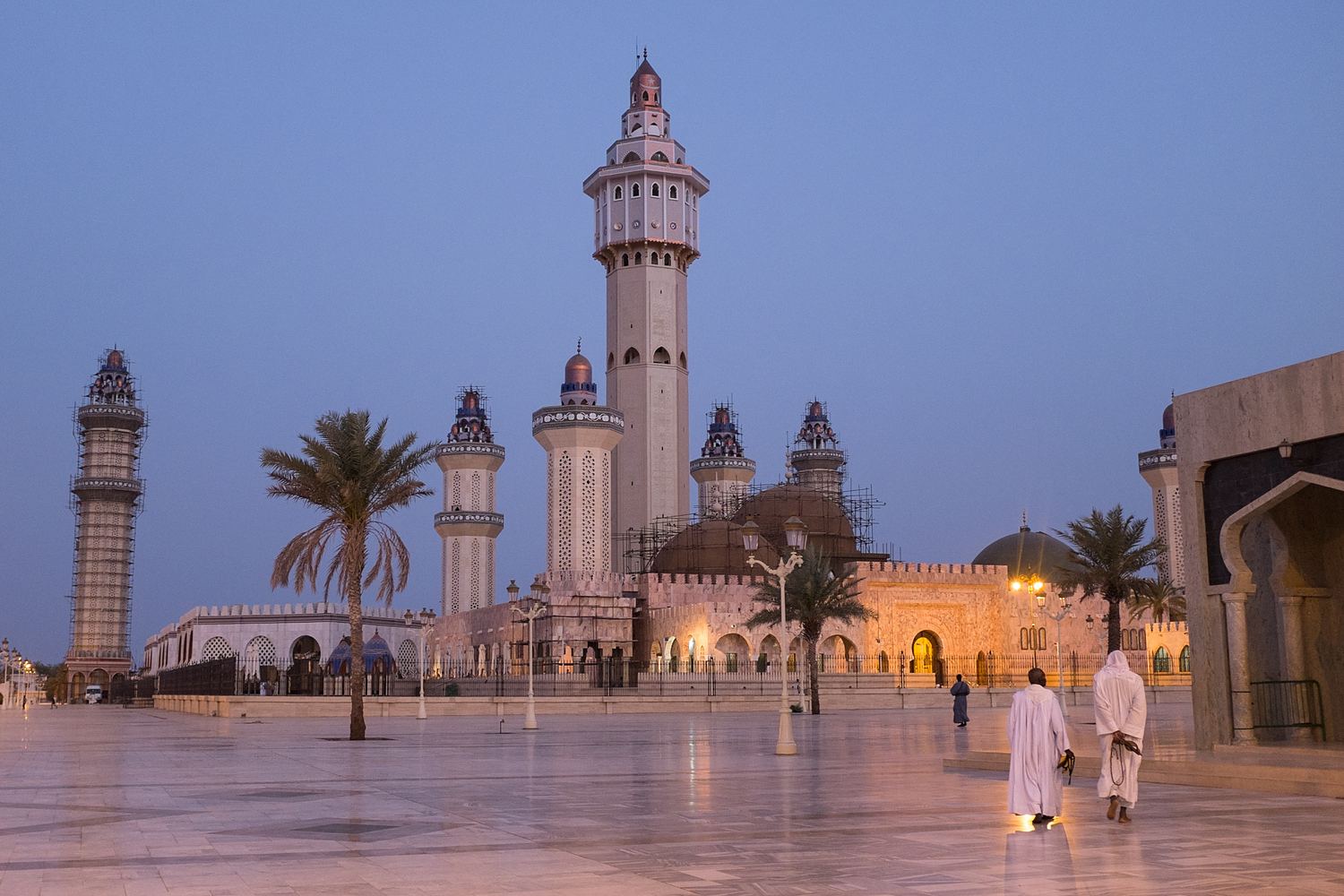
Accueil › Découvrir › Lieux emblématiques › Great Mosque of Touba: entering the holy city as a guest
LIEUX EMBLÉMATIQUES
In Touba, you do not arrive as a tourist but as a guest of the Mouride brotherhood. The history of the mosque, the rules of the holy city, dress, access by motorway and the right time to come.
The Great Mosque of Touba is not discovered like a monument: you are entering a holy city, and it is the city that sets the rules. No smoking, no alcohol, no music in the streets, modest clothing for everyone: here, the visitor is a guest of the Mouride brotherhood (Mouridiyya), and by accepting that from the outset, the visit becomes one of the most powerful in Senegal. At the end of the Ila Touba motorway, the Lamp Fall minaret comes into view before the city does. Come with time, restraint and curiosity: you will leave with far more than a photo.
| Region | Diourbel Region, Mbacké department; in the heart of the city of Touba, in the Baol |
| Type | Active mosque, inaugurated on 7 June 1963, housing the mausoleum of Cheikh Ahmadou Bamba; spiritual centre of the Mouride brotherhood |
| Getting there from Dakar | About 190 to 200 km; 3 to 3½ hours outside the pilgrimage period, by motorway to Thiès then the Ila Touba motorway |
| Recommended time | One to two hours for the mosque and its surroundings; a full day including the drive from Dakar |
| Official fees | No published official entry charge: it is a place of worship, not a ticketed site |
| Best time to go | November to May, on a weekday, avoiding Fridays and well away from the dates of the Grand Magal |
| Related QFS activities | Private Dakar → Touba transfer, vehicle hire with driver by the day |
If you live in Senegal, Touba is part of your horizon, whether you are Mouride or not. You may already have been for a ziarra, a pious visit, or to accompany relatives to the Magal. Come back outside the major gatherings, on a weekday morning: the mosque regains its calm, the courtyards can be crossed without jostling, and you grasp the scale of the place differently. You are also the one who can give friends or family from abroad the best introduction to Touba: the rules explained before setting off, the right clothes in the boot, and respect as the guiding thread.
If you are passing through, do not make Touba a stop to “tick off” on the way to Saint-Louis or the Saloum. Allow a whole day from Dakar, come suitably dressed and accept being accompanied: in Touba, a non-Muslim’s visit is made with a guide from the city, who welcomes you near the mosque and tells you where to go, where not to go and how to behave. Access to certain interior spaces cannot be arranged in advance: it is requested on site, and the answer given is final.
It all began in 1887, when Cheikh Ahmadou Bamba, founder of the Mouride brotherhood, chose this site in the Baol to found Touba. There he preached a path founded on knowledge, work and non-violence. This message worried the French colonial administration, which saw the sheikh’s growing following as a threat.
In 1895, Cheikh Ahmadou Bamba was arrested and deported to Gabon. The day he left for exile, 18 Safar in the Muslim calendar, became the date of the Grand Magal of Touba: the sheikh himself wished the day to be marked by giving thanks, not by lamenting. That is the whole paradox of the Magal, which turns an ordeal into a celebration of gratitude. He died in 1927 and rests in Touba.
The project for the great mosque was conceived in the 1920s, during the founder’s lifetime. The foundation stone was laid in 1932, under the first General Caliph (Khalife général) of the Mourides. Work stopped during the Second World War, then resumed under the second caliph, Serigne Fallou Mbacké, who inaugurated the mosque on 7 June 1963. The work has never really stopped since: extensions, new minarets and renovations have followed one another from one caliphate to the next.
Look at this mosque as the heart of a living organism, not a frozen monument. It is the point of origin of a city that has grown immense, the magnet for a pilgrimage that draws millions of people every year, and the symbol of a brotherhood whose followers, from Dakar to New York, recognise themselves in one name: Serigne Touba.
Réservez votre sortie avec nos prestataires locaux. Le prix du service est distinct des éventuels coûts officiels réglés sur place.
Transparent kayak and drone outing in Dakar
Dakar · 45min to 1h30
Kayaking around Gorée and the Madeleine Islands
Dakar · 30 min, 45 min, 1h
Transparent kayak on the Pink Lake
Dakar Region · 15 min, 30 min
| Fact | Figure | Note |
|---|---|---|
| Founding of Touba | 1887 | by Cheikh Ahmadou Bamba |
| Departure into exile in Gabon | 1895, on 18 Safar | the date commemorated by the Grand Magal |
| Death of the founder | 1927 | buried in Touba |
| Foundation stone of the mosque | 1932 | work interrupted during the Second World War |
| Inauguration | 7 June 1963 | under the caliphate of Serigne Fallou Mbacké |
| Lamp Fall minaret | about 87 m | the tallest, visible from several kilometres away |
| Minarets | 7 | five originally, two added since |
| Cheikhoul Khadim library | 1977 | some fifty metres east of the mosque |
| Ila Touba motorway | 113 km, opened on 20 December 2018 | from Thiès to Touba, passing near Khombole, Bambey and Diourbel |
| Grand Magal 2026 | Sunday 2 August 2026 | 18 Safar 1448 AH |
Touba lies about 190 to 200 km east of Dakar. From the capital, the toll motorway takes you to Thiès, then the Ila Touba motorway, in service since the end of 2018, runs for 113 km to the holy city. Allow 3 to 3½ hours outside the pilgrimage period, longer on the eve of weekends and on days of mass departures. From Blaise Diagne International Airport (AIBD), the drive is similar, without crossing Dakar. The TER (Regional Express Train) does not go as far as Touba: you have to go by road. On arrival, the mosque is in the centre of the city: you cannot miss it, as its minaret serves as a landmark from far away.
Official fees: no official entry charge is published. The Great Mosque is a place of worship, not a ticketed site. The guide who accompanies you is not an entry charge: if a contribution is requested, agree on it simply and politely before the visit. A donation towards the upkeep of the mosque, if suggested, remains entirely voluntary. The only extra cost on the journey is the motorway tolls.
Times: the mosque lives to the rhythm of the five daily prayers, whose times shift with the sun through the year. Check our prayer times in Dakar, Senegal and Touba page before you set off, and aim for a slot well away from any of them. On Fridays, the great midday prayer fills the mosque and its esplanades: it is not the day for a visit.
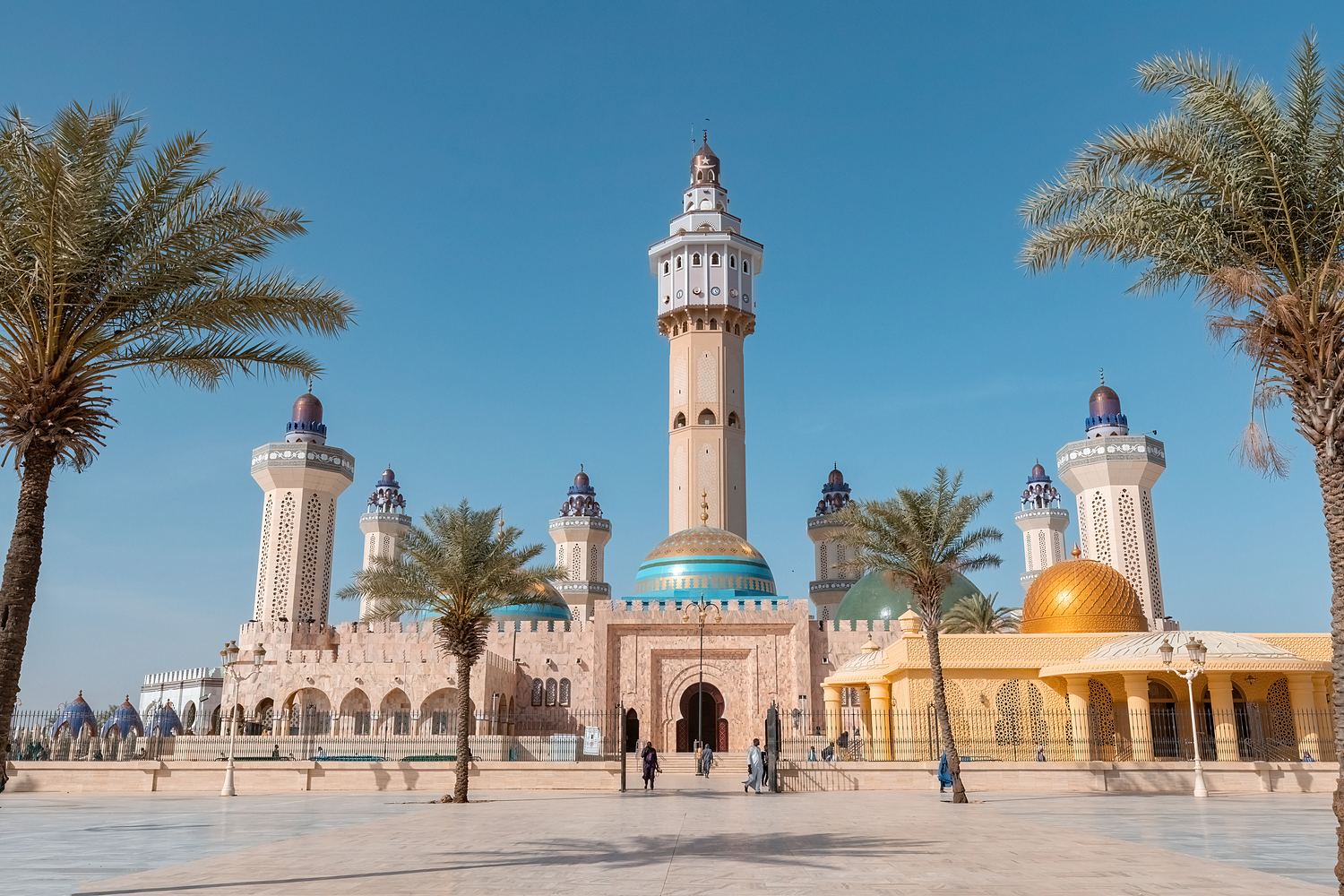
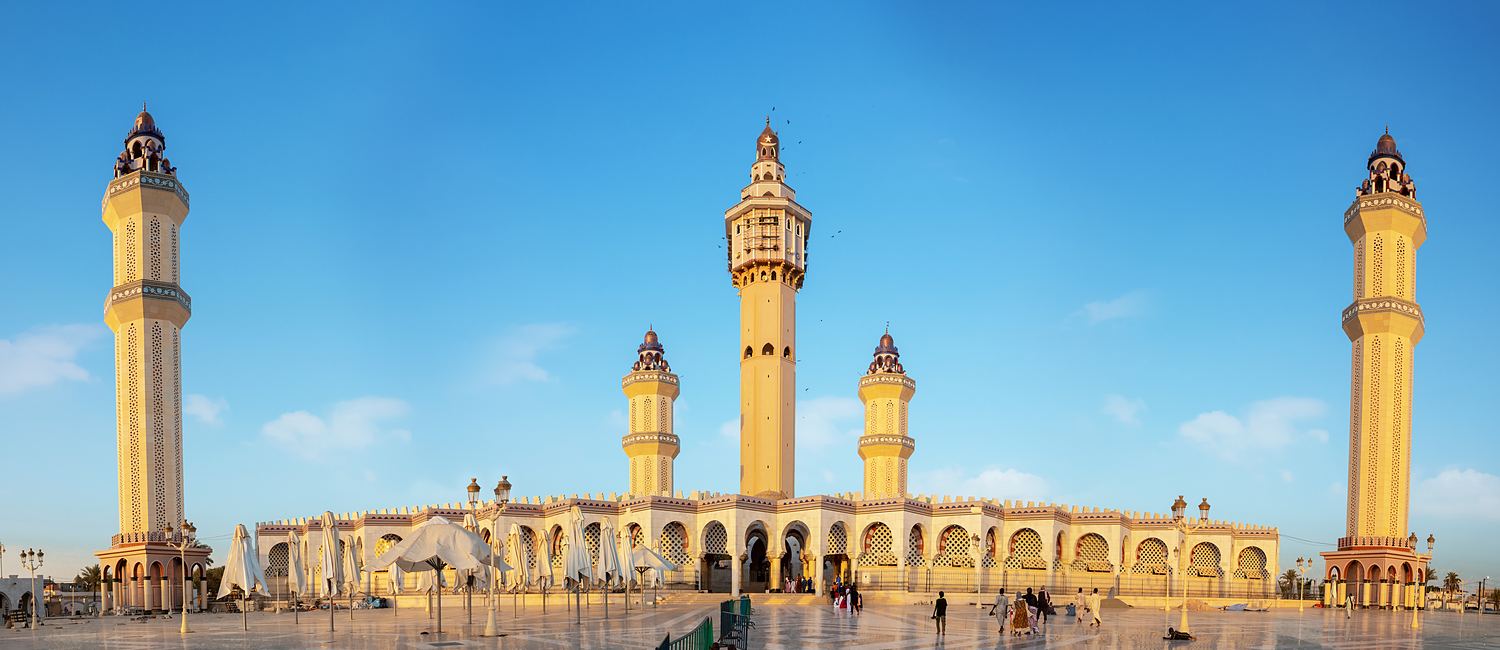
The Lamp Fall minaret. The tallest of the seven minarets, about 87 metres high, bears the name of Cheikh Ibrahima Fall, the disciple whom the Baye Fall claim as their own. Step back across the esplanade to take it in whole, with the domes and the other minarets around it.
The mosque and its courtyards. Colonnades, domes, vast esplanades: the architecture blends Arab inspiration with local craftsmanship, on a scale that surprises you the first time. Take off your shoes wherever you are asked, move in silence and follow your guide, who knows which spaces are open to visitors and when.
The mausoleum of Cheikh Ahmadou Bamba. It lies within the mosque grounds, close to the prayer hall. It is the spiritual heart of the place, the one towards which pilgrims converge, and the most sacred: you approach it, if you are permitted, with the utmost restraint and without a camera. Other tombs, those of caliphs and sons of the founder, surround the mosque.
The Cheikhoul Khadim library. Some fifty metres east of the mosque, this library founded in 1977 by the third caliph, Serigne Abdou Lahat Mbacké, holds handwritten Qur’ans and the khassaïdes, the religious poems written by Cheikh Ahmadou Bamba. It is also known as Daaray Kaamil. It welcomes pilgrims, researchers and students: ask your guide whether a visit is possible on the day you come.
The city around it. The streets around the mosque tell the story of everyday Touba: shops selling religious books and portraits of the sheikh, fabric merchants, the calm crowds of visitors on ziarra. You will also see the Baye Fall, recognisable by their patchwork clothes.
Touba almost touches Mbacké, the main town of the department. On the way back to Dakar, the Ila Touba motorway passes near Diourbel, the regional capital, then joins Thiès, the gateway to Thiès Region and the Petite Côte, where you can extend your trip to Saly and the Somone.
To compare two faces of Senegalese Islam, see our pages on the Great Mosque of Dakar, inaugurated a year after Touba’s and marked by Moroccan craftsmanship, and on the Mosque of the Divinity, set by the ocean in Ouakam. And to plan your days in the capital, use our ideal 3-day itinerary in Dakar.
Excursions, visites guidées et combinés : nos prestataires locaux organisent tout.
Introduction to traditional African games in Dakar
Dakar · 1h
African creative workshop in Dakar
Dakar · 1h
The best slot is mid-morning on a weekday: leave Dakar early, around 06:00 or 07:00, to arrive before the heat and between two prayers. The light is softer and the esplanades are calm. In the late afternoon, the low sun turns the minaret golden, but do not forget the three-hour drive back.
As for the season, from November to May the heat stays bearable in the Baol, far from the cool of the coast. During the rainy season (hivernage), from July to October, storms and humid heat make the day more trying.
The Grand Magal is another matter. This year it took place on Sunday 2 August 2026, 18 Safar 1448 AH, and as every year it drew millions of pilgrims from all over the country and the diaspora. On those days, the motorway and the main roads are saturated, accommodation is provided by the hospitality of families, and the mosque belongs entirely to the faithful. A non-Mouride visitor can attend, but not “sightsee”: if that is your plan, go with a Mouride friend or relative. As the date follows the lunar calendar, the Magal comes around ten days earlier each year: check the proclaimed date before planning a visit in summer.
The easiest way to come to Touba without tiring yourself out is not to drive. Our intercity transfers catalogue offers a one-way trip from Dakar to Touba by motorway, in a private vehicle, priced per vehicle rather than per person. For a return trip in the day, with time for the visit, vehicle hire with driver by the day leaves you free to set your own pace. You will find all our options in the transport & transfers section. The mosque guide is arranged separately, on site.
You pay 20% to secure your booking (the booking fee), and the balance is paid on site, on the day. The Great Mosque has no published official entry charge; depending on the listing, motorway tolls are either included or payable on site and not included in the price. If you live in Senegal, you get the resident rate: up to 30% off depending on the activity (the exact rate is shown on each listing).
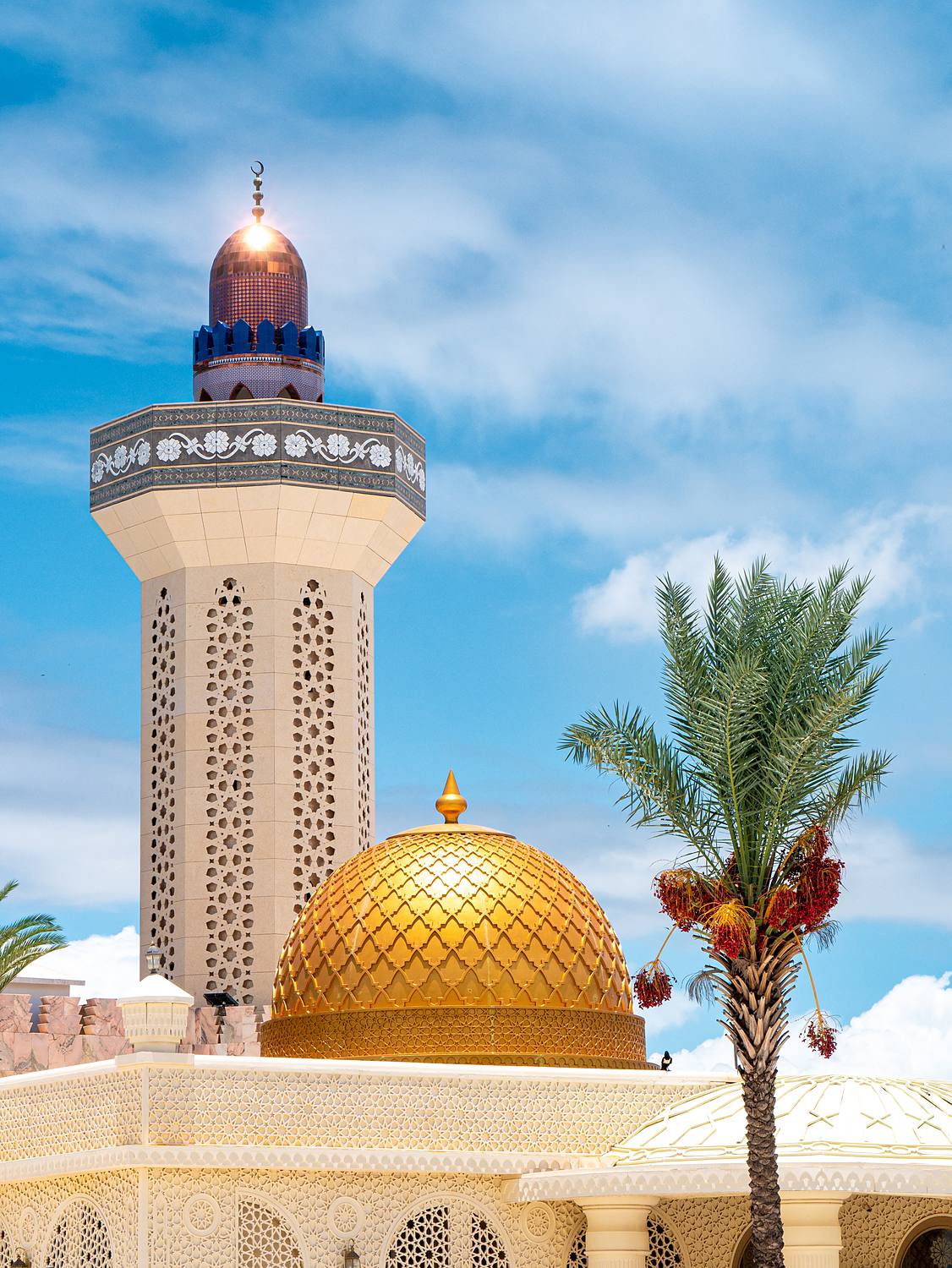
À Touba, on n'arrive pas en touriste mais en invité de la confrérie mouride. Histoire de la mosquée, règles de la ville…
Lire l’article ›En service depuis 1864 et toujours gardé par des hommes, le phare des Mamelles veille sur Dakar depuis la plus haute colline…
Lire l’article ›Une bonne partie de l'eau qui coule des robinets de Dakar vient d'un lac du Sahel, à quelque 250 km au nord-est.…
Lire l’article › Chaque jeudi · AYTHIA ÑU DEM
Les bons plans, les nouveautés et les temps forts du Sénégal, directement dans votre WhatsApp.
 Sur ordinateur ? Scannez ce code pour rejoindre la chaîne.



