Djoudj National Bird Sanctuary: pelicans & season | QFS
Accueil » iconic locations » Djoudj National Bird Sanctuary: the pelican haven that almost drowned under a fern

Home › Locations › Djoudj National Bird Sanctuary › Djoudj National Bird Sanctuary: the pelican haven that almost drowned under a fern

DJOUDJ NATIONAL BIRD SANCTUARY

Djoudj National Bird Sanctuary: the pelican haven that almost drowned under a fern

At Djoudj, the pelicans are not a backdrop to be taken for granted: this marsh had to be saved from a dam, from an invasive fern and from neglect. Here is the story of the park, what you will see from the pirogue, and the right time to go from Saint-Louis.

One of the great bird spectacles of West Africa very nearly vanished, and you owe part of your visit to a tiny weevil. That is what nobody tells you on the landing stage at the Djoudj National Bird Sanctuary: this marsh in the Senegal River delta, where thousands of white pelicans crowd onto their islets, has twice been placed on the List of World Heritage in Danger. Once you know what it has been through, you will never look at the colony in quite the same way. And you will understand why the pirogue stops at a distance.

At a glance

RegionSaint-Louis Region, Dagana department, in the Senegal River delta, right up against the Mauritanian border
TypeNational park and wetland: a large lake, backwaters, pools and reed beds
DesignationsRamsar Site since 1977; UNESCO World Heritage Site since 1981
Getting there from Saint-LouisSome sixty kilometres north, or one to two hours along the N2 towards Ross Béthio, then a track
Getting there from DakarGo via Saint-Louis: 4 to 5 hours by road to the city, then the journey on to the park; a night there is a must
Recommended timeHalf a day in the park, a full day including the round trip from Saint-Louis
Official feesPark entry per person and a vehicle charge, payable on site and not included in the price
Best time to goNovember–April, peaking December–February; the park is closed during the rainy season (hivernage)
Related QFS activitiesBirdwatching, pirogue trips, reserve outings from Saint-Louis

Resident or visitor: two ways to miss Djoudj, only one way to get it right

Do you live in Senegal? The trap is the calendar. Djoudj is the outing you promise yourself every year and then attempt in August, during a holiday, only to find the barrier closed. Pencil it in for the dry season, ideally between December and February, and make it the heart of a weekend in Saint-Louis: arrive on Friday evening, set off before dawn on Saturday, and be back on the island for lunch. If you have children, this is one of the few outings in the country where they will see thousands of birds at once, for real: they will remember it. On activities booked through QFS, you get the resident rate: up to 30% off. Park entry, on the other hand, is an official fee with no discount.

Just passing through? The trap is the distance. Doing Djoudj as a day trip from Dakar means ten hours on the road for an hour and a half on the water. Make Saint-Louis your base for at least two nights, and slot Djoudj into the morning of the second day. If birds are the reason for your trip, set your dates between December and February: that is when the migrants from Europe are at their most numerous. Bring cash, binoculars and a hat, and accept the early start: it is what makes the visit.

A marsh saved twice

To understand Djoudj, put yourself in the place of a spoonbill or a duck that left Europe in the autumn. After days over the Sahara, the Senegal River delta is one of the first great expanses of fresh water it meets south of the desert. A large lake, backwaters, pools and reed beds, north of Saint-Louis, in a loop of the river facing Mauritania: this is where the Senegalese state created the Djoudj National Bird Sanctuary in 1971. It covers about 16,000 hectares. In 1977, it joined the Ramsar Convention’s list of wetlands of international importance, and in 1981 UNESCO made it a World Heritage Site, for the beauty of its waterscapes and for its biodiversity.

The first blow came in the 1980s. The marsh was judged to be under threat, and Djoudj was placed on the List of World Heritage in Danger for the first time, from 1984 to 1988. At the same time, to stop seawater pushing up the river and to irrigate the rice fields of the delta, a dam was built downstream at Diama and completed in 1986. It did its job, but the water regime changed: the delta lost the natural alternation of floods and dry seasons that had kept the marsh breathing.

The second blow was a direct consequence of this regulated river. In the late 1990s, a floating aquatic fern from South America, giant salvinia (Salvinia molesta), exploded in the calm fresh water of the regulated river. It formed mats so thick that they smothered life beneath the surface, blocked the pirogues and closed the open water to the birds. Water lettuce (Pistia stratiotes) and typha, a tall reed, spread too. In 2000, UNESCO put Djoudj back on the List of World Heritage in Danger.

This is where the weevil comes in. Rather than herbicides, ruled out so as not to poison the marsh, Senegal opted for clearing by hand and biological control: a small beetle, Cyrtobagous salviniae, which feeds on nothing but this fern. The first insects were bred at the Djoudj biological station at the very start of the 2000s, then released in large numbers into the delta. The result was spectacular: within a few seasons, the salvinia mats collapsed, and the insects spread of their own accord along the river. In 2006, Djoudj came off the List of World Heritage in Danger.

Today, the vigilance goes on, and it has a human face. Eco-guards from the riverside villages help to watch over the park, alongside state officers. Djoudj is not untouched nature: it is nature held together by sheer effort, and that is precisely what makes a visit so moving.

  • Wildlife reserves & parks

    Guided half day at Djoudj National Bird Park

    Saint-Louis · Half-day (5h)


    From66 000 CFA
    Resident price62 700 CFA−5 %
  • Adventure & outdoors

    Guided excursions in Saint-Louis

    Saint-Louis · 1h30 to several days depending on the option


    From13 200 CFA
    Resident price12 540 CFA−5 %
  • Wildlife reserves & parks

    Djoudj day trip from Saint-Louis: pirogue and horse cart

    Saint-Louis · 1h30, Full day


    From4 400 CFA
    Resident price3 740 CFA−15 %

Key facts & figures

FactFigure
Created1971
AreaAbout 16,000 hectares
Ramsar SiteSince 1977
UNESCO World Heritage SiteSince 1981
List of World Heritage in Danger1984–1988, then 2000–2006
BirdsMore than a million at the height of the season, more than 350 species recorded
Flagship speciesWhite pelican, which nests here in a colony
Other residentsCrocodiles and manatees, rarely seen
Main threat tackledGiant salvinia, controlled biologically in the early 2000s
Distance from Saint-LouisSome sixty kilometres north, one to two hours’ drive

Getting there & official fees

From Saint-Louis, you head north-east up the N2 towards Ross Béthio, then a laterite and clay track leads to the park entrance and the landing stage. Allow one to two hours depending on the vehicle and the state of the track: a high-clearance vehicle or a 4×4 makes the last few kilometres more comfortable. Without a car, the simplest option is an organised outing from Saint-Louis, with transport and a guide. To get to Saint-Louis from Dakar (4 to 5 hours by road), intercity transfers, the airport / Saint-Louis transfers and vehicle hire with driver save you hunting for transport once you are there.

The visit is made with a park guide: the guide is the one who knows which backwater the birds are on that day.

As for fees, there are two things to budget for: park entry, paid per person, and a vehicle charge. These are official fees, set by the national parks administration. They are paid on site, in cash, are not included in the price of your outing, and no discount applies to them. Keep some small notes handy.

What to see

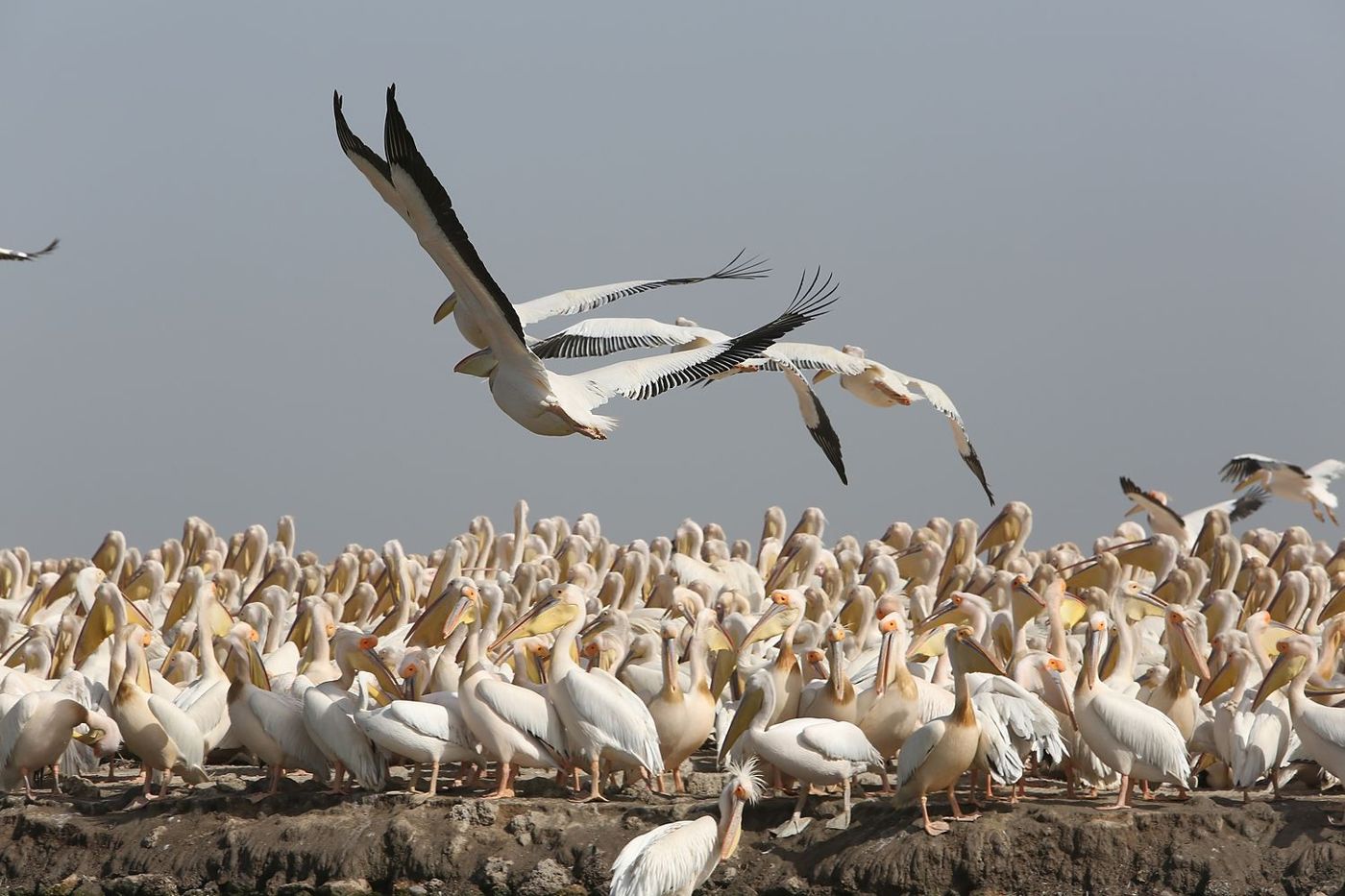
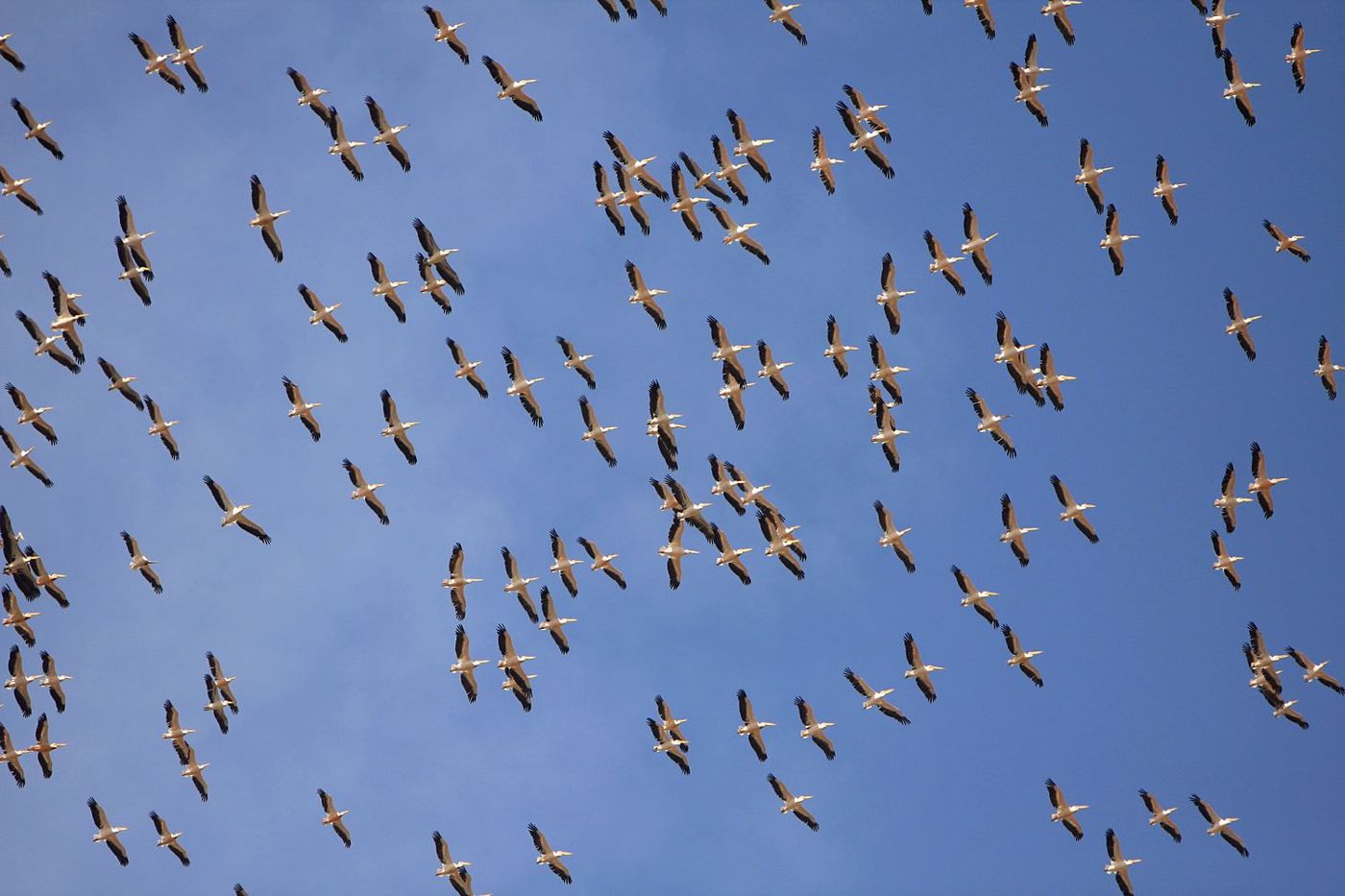
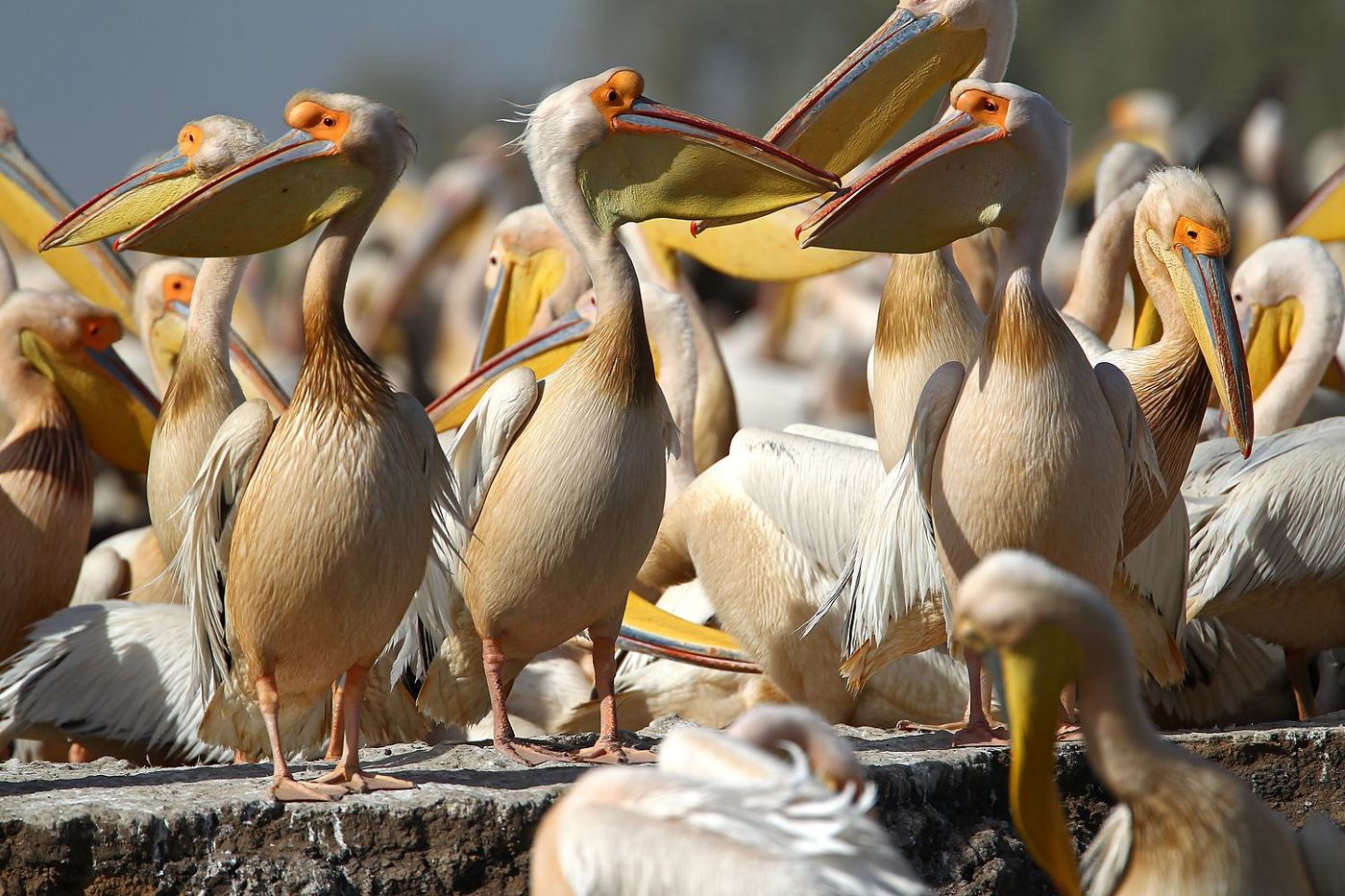
The white pelican colony. The heart of the visit. The pirogue leaves the landing stage and follows the backwaters for about an hour and a half, between the reeds, up to the edge of the islets where the pelicans gather in their thousands. You do not land: you stay at a distance, with the engine idling. That is the rule, and it is what lets you watch them settle, preen, fish as a group and take off in formation, without them fleeing.

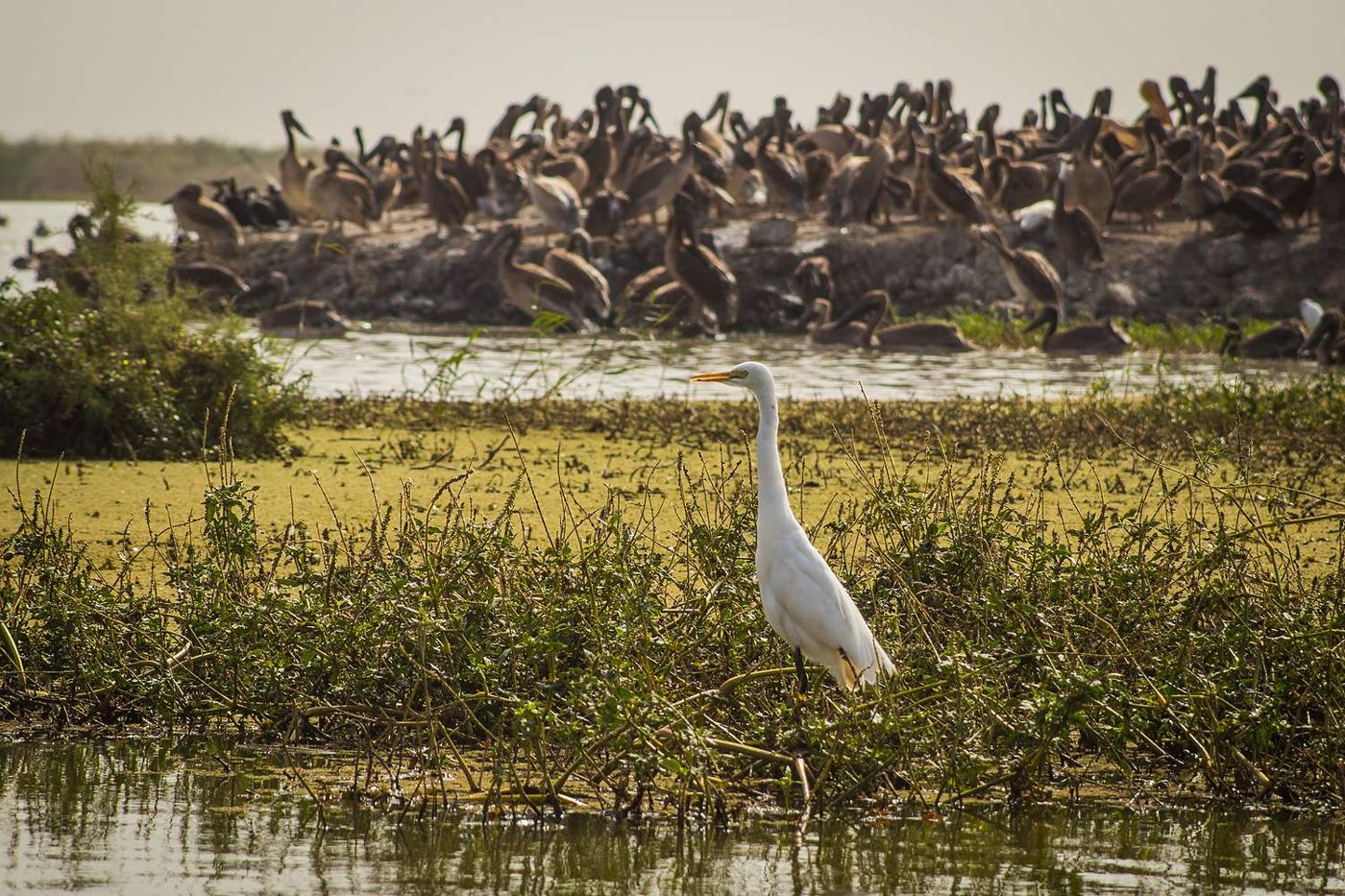
Cormorants and herons. As you go, keep an eye on the low branches and the edges of the reed beds: cormorants, purple herons and egrets are everywhere, often just a few metres from the pirogue.

Flamingos. They tend to keep to the shallow stretches of water. The rest of the visit, by vehicle and on foot, takes you from one lake to the next to get close to them with binoculars, along with spoonbills, waders and ducks from the north.

Birds of prey. Ospreys and fish eagles, those great fishing raptors, perch on the dead trees at the water’s edge. Look up from time to time.

The landscape itself. At Djoudj, everything is horizontal: the water, the reeds, the line of Mauritania in the distance. At dawn, the low light over the marsh is worth almost as much as the birds.

  • Adventure & outdoors

    Guided excursions in Saint-Louis

    Saint-Louis · 1h30 to several days depending on the option


    From13 200 CFA
    Resident price12 540 CFA−5 %
  • Excursions & adventures

    4×4 excursion from Saint-Louis: bush and villages

    Saint-Louis · Half-day (~4h)


    From38 500 CFA
    Resident price36 575 CFA−5 %
  • Water sports & sea activities

    Electric scooter ride in Saint-Louis

    Saint-Louis · 30 min – 1h


    From1 650 CFA
    Resident price1 485 CFA−10 %

Nearby

Djoudj is best experienced from Saint-Louis, its natural base; our Djoudj page brings together the bookable outings. South of the city, Guembeul Reserve can be explored on foot in a morning, with its gazelles, its tortoises and its bird-filled lagoon. Further south, from Gandiol, a pirogue takes you to Langue de Barbarie National Park, another great gathering place for birds, on the sand spit that separates the river from the ocean. Heading east up the river, Lac de Guiers and Podor extend the trip, and on the road back to Dakar, the Lompoul desert offers a night in the dunes. If you come in spring, the Saint-Louis International Jazz Festival livens up the city. For the bigger picture: Saint-Louis Region.

The right time

PeriodWhat changes
NovemberThe season opens and the migrants arrive: numbers rising, the park still quiet
December–FebruaryPeak bird numbers, cool mornings: the best window, and the busiest
March and AprilStill plenty of birds, rising heat: set off very early, the light is superb
Rainy seasonPark closed, difficult track: no visits
Time of dayMorning, from opening time: birds active, cool air; at midday, the marsh goes still

Our advice: leave Saint-Louis before sunrise so that you are at the landing stage as soon as it opens. You will have the pirogue in soft light and the afternoon free to head back, or to follow on with the Langue de Barbarie the next day.

Practical tips

  • What to bring. Binoculars (at least one pair between two), a hat, sun cream and plenty of water: there is no shade on the water. A telephoto lens if you are taking photos.
  • What to wear. Neutral-coloured clothing, closed shoes for the track and the banks, and a light jumper for the dawn start in December and January.
  • On the pirogue. Keep your life jacket on, stay seated, speak softly. Do not ask the boatman to get closer to the colony: the distance protects the nesting birds.
  • Respect the park. No litter, no picking plants, no feeding the animals, no drones without permission. You are in a World Heritage Site.
  • Photos. Photograph the birds freely; the people of the riverside villages, always with their consent.
  • Money. Cash in small notes for the entry fees: do not count on paying by card.
  • With children. The pirogue captivates them, the track tires them out: a snack and some water make all the difference.

Book an activity here with QFS

On QFS, Djoudj is booked under birdwatching and wildlife reserves & parks: as a half-day or full-day outing from Saint-Louis, with the pirogue trip to the pelicans as the highlight, or with a night nearby so that you are at the water’s edge as soon as the park opens. For other outings on the water in the region, browse the pirogue trips.

Every outing is run by an independent local professional. You pay 20% to secure your booking (the booking fee), and the balance is paid on site, on the day. Park entry and the vehicle charge are official fees, payable on site and not included in the price. If you live in Senegal, you get the resident rate: up to 30% off (the exact rate is shown on each listing).

Frequently asked questions

When should you visit the Djoudj National Bird Sanctuary?
From November to April, during the dry season. Migrant bird numbers peak from December to February. The park is closed during the rainy season (hivernage).
How long does it take to get to Djoudj from Saint-Louis?
The park is some sixty kilometres north of Saint-Louis: allow one to two hours along the N2 towards Ross Béthio, then a track. From Dakar, spend a night in Saint-Louis first.
Is park entry included in the price of the outing?
No. Entry is paid per person, plus a vehicle charge. These are official fees, payable on site in cash, not included in the price and with no discount.
How long does the pirogue trip last?
About an hour and a half along the backwaters, up to the edge of the white pelican colony. With the birdwatching on land, allow half a day in the park.
Why was Djoudj on the List of World Heritage in Danger?
The park was first placed on the List in Danger from 1984 to 1988, because of the threats then facing the marsh. It went back on from 2000 to 2006, when the water regime altered by the Diama Dam allowed an invasive fern, giant salvinia, to spread; the fern was finally beaten by biological control.
Can you see pelicans all year round?
Not on a visit: the park is open in the dry season, from November to April, and closed during the rainy season. Aim for December to February for the greatest number of birds.

Read also