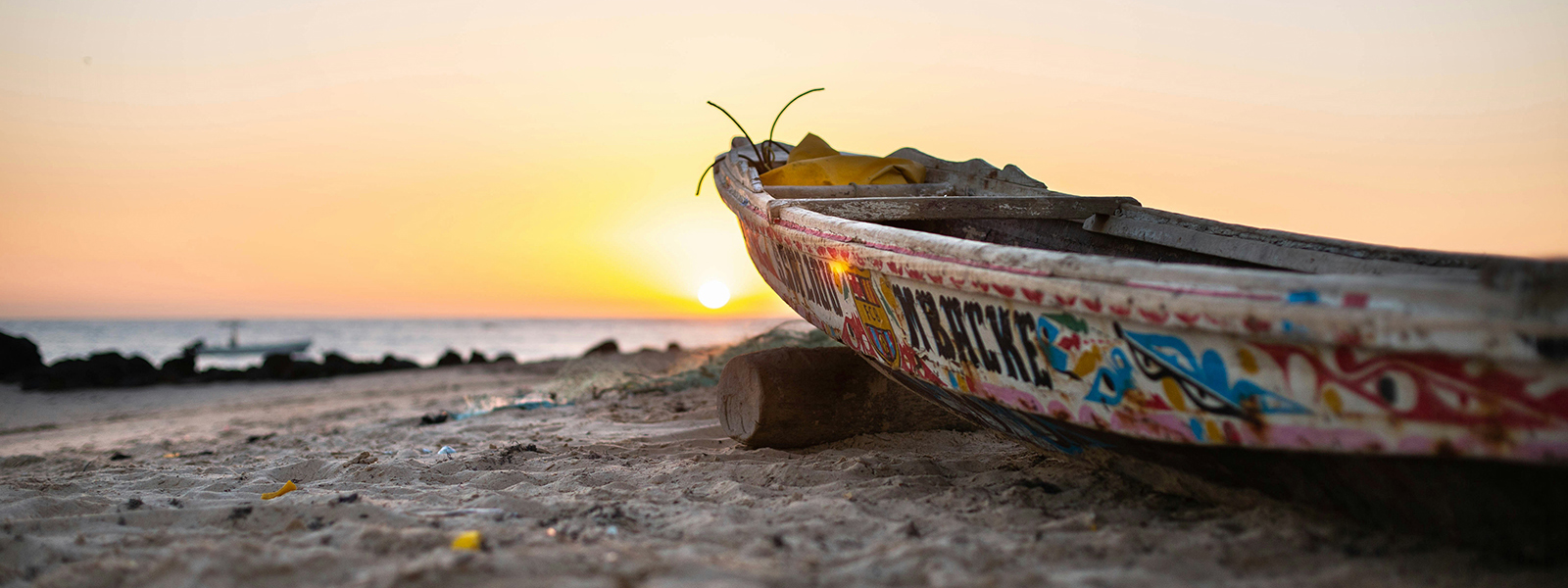
Senegal & the pirogue: the country’s own boat
In Wolof, the pirogue is called gaal. A popular and widespread etymology even derives the country’s name from suñu gaal, “our pirogue”. Historians lean instead towards an origin linked to the Zenaga, a Berber group from the Sahara, but the image has stuck: in Senegal, people speak of the nation as a pirogue in which everyone rows together.
Look at a fishing beach, at Yoff, Soumbédioune, Mbour or Joal. The long, slender hulls are now built from planks, using wood that partly comes from Casamance. Then comes the paint. Every pirogue wears bright colours, often those of the flag, along with waves, stars, patterns meant to bring luck, and above all a name chosen by the owner: that of a relative, a religious guide, a football club. Take the time to read the hulls: they tell the story of the neighbourhood.
Behind these boats are peoples of the water. The Lebou, the first inhabitants of the Cap-Vert peninsula, built their society around fishing: Yoff, Ngor, Ouakam and Rufisque were fishing villages before they became districts of Dakar, and the pirogues still head out through the surf there every morning. In the Saloum Delta, the Niominka, related to the Serer, live on the Gandoul islands, Niodior, Dionewar and Falia: the men fish, the women gather shellfish in the mangroves, and the only way to get around is by pirogue. In Casamance, among the Diola, it links the island villages and the rice paddies reclaimed from the salt water.
Your trips take place in the bolongs. The word refers to the saltwater channels that cut through the deltas, lined with mangroves whose roots carry oysters. The pirogue, with its shallow draught, slips in where a keeled boat would run aground: it is the only real way into the mangroves.
Formats: from fifteen minutes to four days
Each activity’s listing says exactly what it includes; here are the main formats.
- The short outing: fifteen minutes to an hour, on Lac Rose, the Somone lagoon or around the island of Saint-Louis.
- The bolong trip: one to two hours in the mangroves, from Mar Lodj or elsewhere in the Saloum, the format that best captures the feel of the delta.
- The half-day or full-day tour: from island to island, with a stop at a village, a sandbank or a shell mound, in the Saloum or in Casamance.
- The combined pirogue trip: with a little fishing at Saly, with a 4×4 transfer to reach Éloubaline Island or the small bolongs of Lower Casamance, or with a visit to a fishing village on Carabane.
- The birdwatching pirogue: the trip out to the pelican colony at Djoudj, from Saint-Louis.
- The stay in the delta: two to four days in the Sine-Saloum, with several pirogue outings, and sometimes a safari at Fathala.
Where to take a pirogue trip in Senegal
- The Sine-Saloum: the pirogue’s home ground, a delta listed as a UNESCO World Heritage Site in 2011. To the north, from Ndangane, the car-free island of Mar Lodj is 15 to 30 minutes away by pirogue. To the south, Toubacouta opens onto the densest mangroves. Depending on the route, the entrance fee for the Saloum Delta National Park applies: it is payable on site and not included in the price, and each listing says whether it concerns you.
- The Petite Côte: the Somone lagoon, a nature reserve and Ramsar Site, can be explored in an hour, on calm, shallow water; where it applies, the reserve fee is paid on site and not included in the price. At Saly, the pirogue is combined with fishing.
- Lac Rose: a short outing to the middle of the lake, where the salt harvesters work when the season allows. The colour varies and is never guaranteed. No additional official fees.
- Saint-Louis and the north: one to two hours around the island, with no official fees; to the south, from the Gandiol, the pirogue heads to the Langue de Barbarie National Park; to the north, Djoudj and its pelicans, about an hour and a half by pirogue through the backwaters. For these two parks, entry is payable on site and not included in the price.
- Casamance: the greenest maze of all. From Ziguinchor, the road leads to Elinkine, from where a pirogue reaches Carabane Island in under an hour, at the pace of the tide. There is no entrance fee for the islands and villages: no additional official fees.
When to go
Pirogue trips run all year round, but the dry season, from November to May, is the most comfortable: the air is milder, the water calmer, and migratory birds from Europe fill the deltas. For Djoudj, it is a must: the park can be visited from November, with a peak from December to February, and closes during the rainy season (hivernage). From July to October, the mangroves are a vivid green, but the heat is heavy and there are plenty of mosquitoes.
During the day, aim for sunrise or late afternoon: the light is low and the birds return to their roosts. The real boss is the tide. At high tide, the pirogue glides between the mangroves; at low tide, the bolongs drain and reveal mudflats, sandbanks and oysters. The boatman sets the departure time by the cycle of the water: if he moves it by half an hour, go with it: it is for the good of your trip.
Good to know & budget
Bring a hat, sun cream, sunglasses and a bottle of water per person: even for an hour, there is no shade on the water. Protect your phone and camera from spray, wear shoes that can cope with water and mud, and pack long sleeves and repellent for evening trips. A life jacket must be provided: insist on one for children, and wear your own. In parks and reserves, keep your distance from bird colonies, pick nothing and leave nothing behind.
On Que Faire Sénégal, the price shown is the price of the activity. Read the listing carefully: depending on the activity, it is per person or for the whole pirogue. At Lac Rose, for example, one short outing is paid per person and another as a flat rate for the whole pirogue, which takes five or six passengers; the delta tour from Ndangane is also a flat rate per boat. In a group, booking the whole pirogue often works out better. You pay 20% to secure your booking (the booking fee). The balance is paid on site, on the day of the trip. If you live in Senegal, you get the resident rate: up to 30% off (the exact rate is shown on each listing). Finally, the official fees of the parks and reserves (Djoudj, Langue de Barbarie and, depending on the route, the Saloum Delta or the Somone lagoon) are payable on site and not included in the price; elsewhere, no official fees apply.
Who is it for?
For everyone, or nearly: you sit down, the boatman does the work, and no particular fitness is required. Families will start with a short outing, at the Somone or Lac Rose, before trying the bolongs. Photographers and birdwatchers will head for Djoudj, the Langue de Barbarie and dawn in the Saloum.
The resident has a decisive advantage: choosing the moment. A weekend in Ndangane or Toubacouta, leaving on Friday, pirogue at dawn on Saturday. The resident rate makes these regular returns affordable. The visitor, for their part, must above all avoid one trap: the day-long “islands” excursion from the beach resort, where you spend more time on the road than on the water. Sleep near the landing stage, for at least one night, and keep two outings at different times: the morning delta and the evening delta are nothing alike.
If you are in Saint-Louis in summer, do not look for a quiet boat trip on regatta day. Every year, in July or August, the fishing districts of Guet Ndar (Lodo, Dakk and Pondokholé) launch their great racing pirogues on the river, packed with rowers who strike the water to the rhythm of drums and songs. The banks fill up; the elders say they inherited this race from their fathers. On that day, the pirogue is no longer a tool: it is a source of pride.
Frequently asked questions
Do you need to be able to swim for a pirogue trip?
No. You stay seated, with a boatman in charge, usually on calm water. A life jacket must be provided; insist on one for children and wear your own, especially on the river and near river mouths.
Is the price per person or per boat?
It depends on the activity, and the listing says which. Both exist, sometimes in the same place: at Lac Rose, one short outing is paid per person and another for the whole pirogue, and the delta tour from Ndangane is a flat rate per boat. In a group, compare.
Why does the departure time change?
Because of the tide. The bolongs fill and drain twice a day, and some crossings can only be made at a precise point in the cycle. Stay flexible about the time.
Are there charges to pay on site?
First, the activity itself: you pay 20% to secure your booking (the booking fee), and the balance is paid on site, on the day of the trip. For Djoudj and the Langue de Barbarie and, depending on the route, the Saloum Delta or the Somone lagoon, the entrance fee is payable on site and not included in the price; the listing says whether it applies. At Lac Rose, on Mar Lodj or on Carabane, no additional official fees.
Is there a special rate for residents?
Yes. If you live in Senegal, you get the resident rate: up to 30% off depending on the activity (the exact rate is shown on each listing). It does not apply to park entrance fees.