Senegal & animal parks: the land of the lion that so rarely sees one
The paradox is obvious once you think about it. The lion has been on the state’s coat of arms since 1965, it gives the national teams their nickname, it is in every conversation in the stands. And yet most Senegalese have never seen one. The country’s wild lions now survive only in Niokolo-Koba, in the far south-east, where they form a small population closely monitored by scientists.
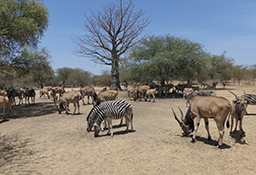
From the end of the 20th century, fenced private reserves filled that gap: giraffes, rhinos, zebras and antelopes brought in from elsewhere were introduced into protected savannahs where you watch them from a vehicle. Bandia, on the Petite Côte, is the most visited example. It makes no secret of being a savannah restocked by human hand: there are no lions or elephants in the reserve, and that is precisely what makes it so easy to do with a family. The lions are found at a neighbouring private site and at Fathala, south of the Saloum, in dedicated areas.
Alongside these savannahs, two other traditions matter. The first is conservation: the Tortoise Village, in Noflaye, takes in and breeds threatened tortoises, including the African spurred tortoise, the continent’s largest land tortoise, which can weigh close to a hundred kilos. The second is the city park: in Dakar, the Hann Forest and Zoological Park, created in 1903, is still the place where families come for a breath of fresh air. Our advice, consistent across the whole site: come for the forest, the lake and the shady paths. The zoo has been repeatedly criticised for its facilities, and it is not what we recommend.
Formats: what you can book
- Guided visit to the Tortoise Village: about 45 minutes with a guide, from the nurseries to the large African spurred tortoise enclosures. Separate rates for adults, children aged 3 to 16 and school groups; there is also a format with a meal.
- Exotic park by Lac Rose (Pink Lake): a visit to see the animals only, or a full day with pool, meal and guide. The price is per person.
- Exotic park in Nguéniène: a guided visit of about 45 minutes, which you can extend into a half-day or full day with the pool and a picnic, as you prefer. The park can also be hired for a private booking by a group.
- Safari at Bandia: the savannah by vehicle, with giraffes, rhinos, zebras, buffaloes, ostriches and crocodiles, on its own or combined with Lac Rose or the Somone lagoon in a single day.
- Meeting the lions near Bandia: as a half-day after the safari, or a full day with transport and guide. You watch the lions from a secure vehicle, without getting out.
- Fathala, safari and lion encounter: a day south of the Saloum, transport and guide included, with a safari in the forest and an approach to the lions supervised by the keepers.
For trips combined with the dunes, see also 4×4 (safari & dunes); for a children’s outing without animals, see amusement & play parks.
Where to see animals on a leisure outing in Senegal
- Around Dakar: Sangalkam and Lac Rose. The ideal pairing for a day without a long drive: the tortoises in the morning, about thirty kilometres from the capital, then the exotic park or the lake in the afternoon. Allow 45 minutes to 1½ hours’ drive depending on traffic. The lake’s pink colour varies with the season and the light: never take it for granted.
- The Petite Côte: Bandia and Nguéniène. The heart of the section. Bandia is about half an hour from Saly, and several listings pick you up in Saly, the Somone or Ngaparou. The exotic park in Nguéniène, a little inland, offers a family day away from the beach, with a pool.
- South of the Saloum: Fathala. Further afield, near Toubacouta and the border with the Gambia, in the Saloum Delta National Park. This is the outing worth the drive, ideally with a night in Fatick Region.
- Dakar itself: Hann Park for a walk in the forest, no booking needed. The children’s activities you can book there are presented under family days & children’s outings.
When to go
The dry season, from November to May, is the most comfortable: dry tracks at Bandia and Fathala, sparser vegetation that makes it easier to see the animals around the waterholes, cool mornings. The rainy season (hivernage), from July to October, makes the bush beautiful but denser, the heat sticky and some tracks muddy after storms; outings still go ahead, with time to spare on the journey and an eye on the weather.
The time of day matters more than the month. Animals move about in the cool and shelter in the shade during the hot hours: a safari at opening time or in the late afternoon is worth two at midday. The tortoises are more active in the morning too. For peace and quiet, go on a weekday; weekends, the summer school holidays and the days after festivals fill up the parks closest to Dakar.
Good to know & budget
The rules for approaching animals are non-negotiable. In a safari vehicle, you stay seated and only get out where the guide allows. With the lions, you follow every one of the keepers’ instructions to the letter. Everywhere, you do not feed the animals unless invited to. Bring a hat, water, sunscreen, neutral colours for the safari and cash in small notes: card machines are rare outside the towns.
An honest word about the lions: the ones you approach near Bandia or at Fathala are animals used to people, living in fenced areas. It is an impressive encounter, not wildlife watching. For free-roaming lions, it is Niokolo-Koba, and luck.
On Que Faire Sénégal, the price shown is the price of the service. You pay 20% to secure your booking (the booking fee). The balance is paid on site, on the day. If you live in Senegal, you get the resident rate: up to 30% off (the exact rate is shown on each listing). Check the price unit carefully: most outings are priced per person, but some excursions require a minimum of two participants, and vehicle hire in the reserve or at the lion site may be added for the group.
As for entry: Bandia, the lion enclosure and Fathala are private sites, so there is no public entry fee. Depending on the listing, entry is included or payable on site and not included in the price, sometimes along with the reserve guide and the vehicle; each listing gives the details. At the Tortoise Village, the guided visit includes entry, except in the format with a meal, where entry is payable on site and not included in the price.
Who is it for?
Toddlers are in their element at the Tortoise Village and the exotic parks: short visits on foot, and a pool to end the day. As soon as a child can manage half a day in the car, the Bandia safari becomes the highlight of the trip, with no big cats to worry the more sensitive ones. The lion encounter is better suited to older children, teenagers and adults; at Fathala, age requirements are set by the supervising team and shown on the listing. School groups have their own rates at the Tortoise Village, and the exotic park in Nguéniène can be booked privately for a group.
If you live in Senegal, this is the section for Saturdays done right: the Tortoise Village and Lac Rose without taking a day off, Bandia as a round trip from Dakar or the Petite Côte, an exotic park when it is too hot for the beach. If you are passing through, set aside a day for one wildlife outing: Bandia from your hotel in Saly or the Somone, Fathala if you are heading down to the Saloum, the tortoises on your day of arrival or departure, since the airport road is not far away.
Near Bandia, the site where the lions live has taken the opposite approach to a zoo. Rather than shutting the big cats in cages, its managers explained to the press, it is the visitors who are shut in. You climb into a secure 4×4, the doors stay closed, and the lions, used to these visits, come right up to the window. A zoo in reverse, in short: the animal roams free, the human watches from a cage on wheels.
Frequently asked questions
What’s the difference from the Wildlife reserves & parks section?
Here, these are short, easy leisure outings: exotic parks, the Tortoise Village, a mini-safari at Bandia, meeting the lions. National parks and watching wildlife in its natural habitat come under wildlife reserves & parks and safari.
Are there lions at Bandia?
Not in the reserve, where you see giraffes, rhinos, zebras, buffaloes and ostriches. The lions live at a neighbouring private site, where you watch them from a secure vehicle; several listings combine the two.
Which outing should I choose with young children near Dakar?
The Tortoise Village, in Sangalkam, then the exotic park or Lac Rose in the afternoon. Short visits on foot, with the option of a pool at the exotic park. Set off early to avoid the heat.
Do I have to pay an entry fee in addition to the price shown?
It depends on the listing. Bandia, the lion enclosure and Fathala are private sites with no public entry fee: entry is either included or payable on site and not included in the price, and the listing says which. At the Tortoise Village, the guided visit includes entry, except in the format with a meal.
How do I book and how much do I pay in advance?
You pay 20% to secure your booking (the booking fee), and the balance is paid on site, on the day. If you live in Senegal, you get the resident rate: up to 30% off (the exact rate is shown on each listing).