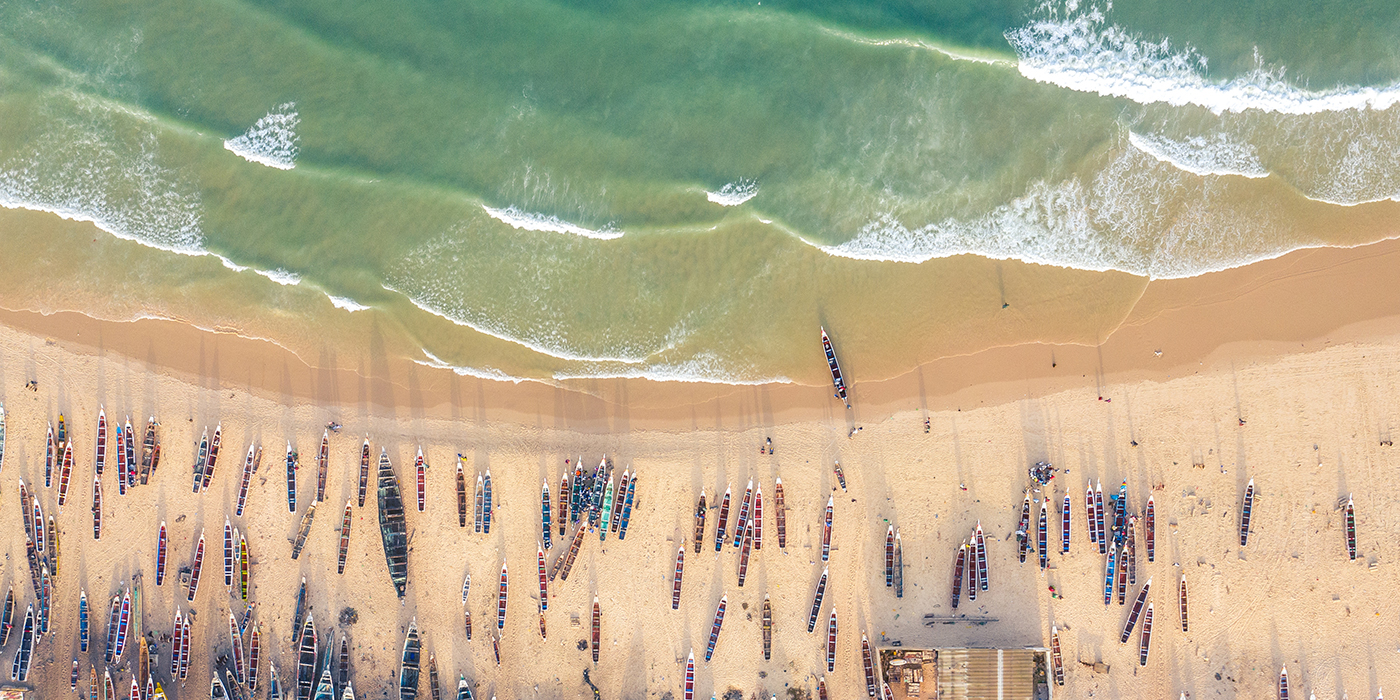
Senegal & the beach day
Senegal lives facing the Atlantic, but its ocean is no swimming pool. North of Dakar, the coast takes the swell head-on; around the Cap-Vert peninsula, currents tighten between the rocky points; to the south, the Petite Côte is better sheltered, and that is where the country built its major beach resort. Saly, developed by the state through SAPCO, opened in the 1980s; since then, breakwaters laid offshore have recreated calmer pools in front of the beach. Most of the days in this category are found there.
The rules on swimming, however, are not a matter of personal taste. Since 2022, an order from the Ministry of the Interior has set, for the whole country, the list of beaches where you may swim and those where it is forbidden. It was issued after deadly summers: drownings peak in July and August, during the hottest spells, and most happen on prohibited beaches. Above all, remember that a permitted beach does not necessarily have a lifeguard out of season, and swimming at night remains forbidden everywhere, even where it is allowed by day.
On the Dakar coast, that gives you a simple map to remember. Ngor, Ngor Island and Yoff are among the permitted beaches and remain the most popular with the capital’s swimmers. At the Almadies, part of the area is off-limits, notably the rocky point: you go there for the sunset, not to swim. At Guédiawaye and Malika, swimming is simply forbidden: violent currents, repeated drownings every hot season. Elsewhere, the signs on site and the lifeguards’ flag are what count, not a list copied from a forum; press reports contradict one another from one site to the next.
That is where a day at a venue makes sense: you spend the day in front of a stretch of beach the venue knows, with a pool for days when the sea is not suitable. Beaches remain public in Senegal; what you are booking is comfort and access to facilities, not a slice of ocean.
Formats: what a day includes
- Family day: sun loungers and a shady spot, activities for the children, meal included, beach games. Offered at Saly, Ngaparou, the Somone and Dakar.
- Day for two: a quiet beach, lunch and a treatment for two, at Ngaparou or beside the Somone lagoon. Details of the treatment are on the listing.
- Lunch & pool: a meal with a drink and pool access for the day, near Lac Rose. The simplest format, priced per person.
- Picnic on a Saloum beach: departure from Toubacouta by pirogue with a guide, crossing to Sipo Island, lunch on the sand with oysters and local juices, a swim in the creek.
Before booking, read three lines on the listing: what is included (lounger, pool, meal, drinks, activities), access times, and the price basis. Depending on the format, the rate is per person, per couple or per family.
Where to spend a beach day in Senegal
- Saly and Ngaparou: the heart of the offer. A calmer sea than Dakar’s, pools sheltered by the breakwaters at Saly, a quieter beach at Ngaparou, a few minutes away. Allow one to two hours’ drive from Dakar on the toll motorway, under an hour from Blaise Diagne International Airport (AIBD).
- The Somone: the lagoon, a nature reserve since 1999, offers shallow water with no breakers, fringed with mangroves. The choice of families with young children, and of couples who want silence. Keep an hour for one of the pirogue trips through the mangrove trees.
- Dakar: a day without leaving the city, handy for a resident’s Sunday. For swimming, stick to the permitted beaches (Ngor, Yoff); at the Almadies, follow the signs; at Guédiawaye, look at the sea without going in.
- Lac Rose: 30 to 40 km from Dakar, lunch and a pool beside the lake, to combine with an outing into the dunes. The pink colour varies with the season and the year: it is never guaranteed.
- Toubacouta and the Sine-Saloum: here, you reach the beach by pirogue. No sun loungers, but an island beach amid the bolongs (tidal creeks), a lunch of produce from the delta and calm water.
When to go
The dry season, from November to May, offers the most comfortable days: clear skies, dry air, strong sun that is bearable in the shade of a parasol. From December to February, the harmattan can veil the sky with dust and cool the mornings; bring a light layer for arriving and leaving.
The water follows the opposite calendar: around 20 °C at its coolest, in February–March, and nearly 28 °C at its warmest, in September–October. The rainy season (hivernage), July to October, brings humid heat, sometimes heavy downpours and a bigger swell. It is also the time of the biggest crowds on the beaches and of drownings: if you come then, the venue’s pool and the Somone lagoon are your best allies.
As for the day of the week, Saturday and above all Sunday see families arrive from Dakar and Thiès: book early, set off in good time and head back before late afternoon to avoid the motorway jam. On weekdays, the same beach is often yours. From 31 October to 13 November 2026, Saly hosts the beach and sea events of the Dakar 2026 Youth Olympic Games (YOG): expect crowds on the seafront.
Good to know & budget
In your bag. Swimsuit, a towel if the listing does not provide one, high-factor sun cream, hat, sunglasses, water for the journey. The sun is fierce even when the breeze makes it feel cool; reapply sun cream after every swim. For the Saloum, add sandals you can wear in the water and a dry bag for the pirogue.
In the water. Swim during the day, in front of the area indicated by the venue, never alone or after an overly boozy meal. A child who cannot swim stays in the pool or the lagoon, with an adult beside them. If a current carries you away, do not swim against it: let it take you parallel to the shore, then come back in at an angle. And whatever the venue, swimming at night is forbidden.
On site. Beachwear on the beach, modest clothing to walk through a village, particularly at Sipo.
Booking and payment. The price of each day is shown on its listing: it is the price of the service, according to the format and price basis stated. You pay 20% to secure your booking (the booking fee), and the balance is paid on site, on the day. No additional official fees: the crossing to Sipo is included in the picnic. If you live in Senegal, you get the resident rate: up to 30% off (the exact rate is shown on each listing).
Who is it for?
For families first of all, who gain a day with no organising and children who are kept busy. For couples, looking for midweek calm in the middle of the weekend. For groups of friends who want a base with shade and a table.
Residents, Senegalese or expatriate, find a break close to home: a Sunday at Ngaparou or the Somone, a lunch break at Lac Rose, with the resident rate as a bonus. Travellers find a safe way to enjoy the ocean without knowing the currents, in the middle of a busy trip: a recovery day after a safari at Bandia, a picnic in the Saloum between two nights in Toubacouta. To extend the experience, see traditional massage, the whole wellness & relaxation section, or family days & children’s outings.
On Sipo Island, where the picnic pirogues come ashore, visitors were for many years welcomed by Fatou Mané, known as the queen of Sipo. She had inherited the role from her father, on an island whose village had been founded by an ancestor in the early 20th century; guardian of the sacred grove, she greeted the curious with great humour, and the tourism community paid tribute to her in July 2021. She passed away on 12 April 2022. Her son, Issa Touré, has taken over the role and watches over the island’s traditions: when you land, say hello before you take photos.
Frequently asked questions
What is a private beach day?
It’s a day pass to a seaside or lagoon-side venue: sun lounger, shade, and often a pool and a meal depending on the format. The beach remains public; you are booking the comfort and the facilities.
Is the meal included?
In most formats, yes: family days, days for two, lunch & pool at Lac Rose and the Sipo picnic all include a meal. The details, including whether drinks are included, are on each listing.
Where can you swim safely near Dakar?
On the permitted beaches, such as Ngor, Ngor Island and Yoff, during the day and where there is supervision. Swimming is forbidden at Guédiawaye, at Malika and on part of the Almadies, and everywhere at night.
Which day should I choose with young children?
The Somone lagoon, with its shallow water and no breakers, or a format with a pool at Saly or Ngaparou. The family days include activities for children.
How does payment work?
You pay 20% to secure your booking (the booking fee), and the balance is paid on site, on the day. No additional official fees; if you live in Senegal, you get the resident rate: up to 30% off (the exact rate is shown on each listing).