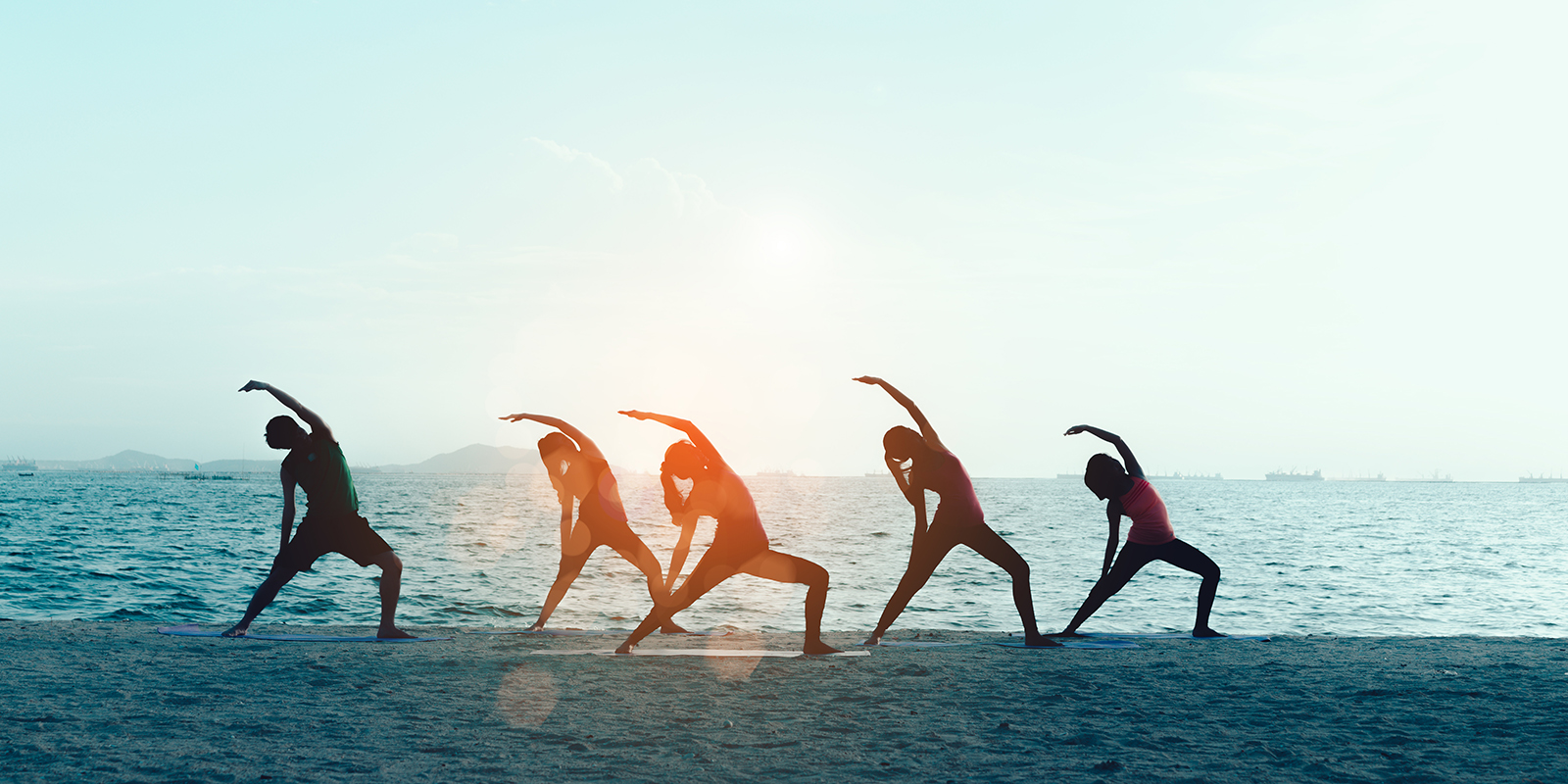
Senegal & yoga: an imported practice with a place in the sun
Yoga came from elsewhere, and it is in the big cities that it has settled. It has no local roots, and we will not invent any for it. The country has its own ways of finding inner calm and caring for its people; they have nothing to do with these classes and are not something you book.
What yoga has gained here, on the other hand, is a public stage. Ever since the United Nations General Assembly made 21 June the International Day of Yoga, in a resolution adopted on 11 December 2014, Dakar has regularly marked it with the Embassy of India, and not in a closed studio: in the open air, at sites everybody knows. In June 2016, the session was already held at the foot of the African Renaissance Monument, open to all, and the event has returned there several times since.
The rest comes down to the capital’s setting and rhythm. Dakar starts work early, moves slowly through traffic and goes to bed late; an hour spent doing nothing but breathing has a particular value here. And the peninsula is surrounded by ocean: after a class, the seafront at the Almadies, Ngor or Yoff lends itself to a few minutes’ walk facing the water, to make the calm last a little longer before you head back into the traffic.
Formats: from a one-hour class to a meditation pack
- Group yoga class in Dakar (1 hour): postures, breathing and a moment of letting go, in a small group, for all levels. The mat is provided in the studio.
- Private class in Dakar, in the studio or at home (1 hour): a teacher just for you, so you can progress at your own pace. At home, simply set aside a clear, quiet corner.
- Kundalini yoga in Ngaparou, group class (1¼ hours): a practice that links breathing, postures, concentration and relaxation, at set times. Mat and cushion included.
- Kundalini yoga in Ngaparou, private class (1½ hours): for a group of 1 to 12 people, with family, friends or colleagues. Book ahead.
- Guided meditation in Dakar (1 hour): a session to learn, step by step, how to rest your attention on your breath, with no previous experience.
- Pack of 8 meditation sessions: to build a regular practice rather than a one-off break.
- Group meditation session (2 hours) and meditation at home (1 hour): the guide comes to you, or you share a longer session with others.
If you are looking for effort and strength work, see personal training & fitness; for qi gong and tai chi, martial arts (Kung Fu, Qi Gong, Tai Chi). And if you would rather lie down without moving, the energy & holistic treatments category offers a session with no contact and no effort.
Where to practise yoga and meditation in Senegal
- Dakar: yoga classes and guided meditation, in a studio or at home. This is the weekday option: a class after work, a meditation early in the morning, without crossing the city if the teacher comes to you.
- Ngaparou, on the Petite Côte: kundalini yoga, as a group or privately. A session slots easily into a weekend by the sea, between Saly and the Somone lagoon.
That is all on offer for now: there are no sessions in the Sine-Saloum or in Casamance. This page will grow as new classes are added.
When to practise
Classes take place indoors and can be booked all year round. The season mainly matters for your comfort before and after. From November to May, in the dry season, the air is lighter and the mornings cool: that is the most pleasant time to follow a class with a walk facing the ocean. It is also the season of the harmattan, the dry wind that blows mainly from December to February and carries fine dust: on days when the horizon turns white, drink more and keep your breathing gentle.
The rainy season (hivernage), from July to October, brings humid heat and downpours. Kundalini yoga and dynamic classes become more demanding: stay hydrated, slow down, and go for early morning or late afternoon. All year round, the rule is the same: never in the hottest part of the day, and never straight after a big meal.
Good to know & budget
What the practice is, and what it is not. Yoga and meditation help you relax and refocus for the length of the session. They do not cure any illness or treat back pain or anxiety, and are no substitute for medical advice or care. If you are on treatment, never stop it in favour of sessions. Injury, pregnancy, a health problem: tell the teacher before you start, and they will adapt the class or tell you to sit it out.
How to prepare. Loose clothing, a bottle of water, a light stomach. Arrive a few minutes early: a yoga class you start in a rush gets off to a bad start.
Per person or per group. The price shown on each listing is the price of the service. Most formats are priced per person. The exception is Ngaparou: the private class for 1 to 6 people is at a group rate, whatever the number of participants within that range, while the one for 7 to 12 people is priced per person.
Booking and paying. You pay 20% to secure your booking (the booking fee), and the balance is paid on site, on the day of the session. There are no additional official fees. If you live in Senegal, you get the resident rate: up to 30% off (the exact rate is shown on each listing). To benefit, create your resident account.
Who is it for?
For beginners first and foremost: every class in this category welcomes people who have never unrolled a mat. For those who already practise elsewhere and want to keep it up during a stay. For a family, a group of friends or a team, with the private class in Ngaparou or group meditation. And for those who like neither effort nor crowds: meditation at home.
If you live in Senegal, whether you are Senegalese or an expat who has settled here, think of it as a regular appointment rather than an occasion: a class every week in Dakar, the pack of 8 meditations over two months, or a kundalini session on weekends spent on the Petite Côte, with the resident rate thrown in. If you are passing through, keep a session for the middle of your stay, when sightseeing fatigue sets in, or for your last day, before a night flight: an hour spent breathing beats another hour in the traffic jams.
In June 2026, the International Day of Yoga returned to the site of the African Renaissance Monument, on one of the Mamelles hills. The Minister of Youth and Sports and the Ambassador of India joined the participants there, mats unrolled beneath the great bronze statue that towers over the city. Ten years after the 2016 session in the same spot, yoga is still not a Senegalese tradition. But it now has its regulars, and a fixed date in the calendar.
Frequently asked questions
Do I need to be flexible or to have practised before?
No. The yoga classes, kundalini yoga and guided meditation welcome all levels, beginners included. The teacher adapts the postures; just mention any injury, pregnancy or health problem before you start.
Can yoga or meditation cure stress or back pain?
No. These are wellness practices that help you relax in the moment. They do not cure any illness and are no substitute for medical advice, treatment or care. If you have a health problem, see a doctor first.
Where can I practise with Que Faire Sénégal?
In Dakar, for yoga classes and guided meditation, in a studio or at home, and in Ngaparou, on the Petite Côte, for kundalini yoga as a group or privately.
Is the price per person or per group?
Per person for most formats. The private kundalini yoga class in Ngaparou is at a group rate for 1 to 6 people, then per person for 7 to 12 people. The details are on each listing.
How does payment work?
You pay 20% to secure your booking (the booking fee), and the balance is paid on site, on the day of the session. There are no additional official fees. If you live in Senegal, you get the resident rate: up to 30% off (the exact rate is shown on each listing).
When is the best time to practise?
All year round, since the classes take place indoors. The dry season, from November to May, is the most comfortable; during the rainy season (hivernage), from July to October, go for early morning or late afternoon and stay well hydrated.