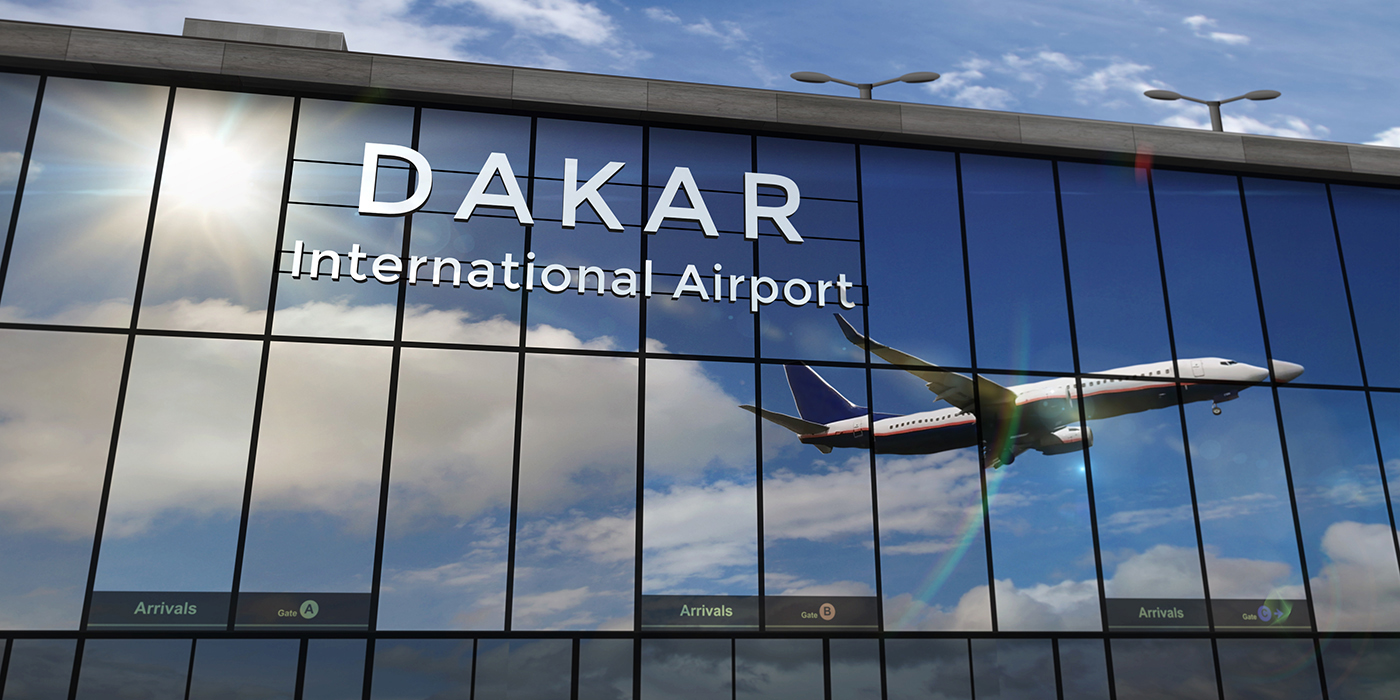
Senegal & the airport transfer
Transfers became a talking point on 7 December 2017. That day, the old Léopold Sédar Senghor Airport in Yoff, right on the edge of the city, closed its runways to commercial flights, and all traffic switched to Blaise Diagne, built in Diass, in Thiès Region. In a single day, Dakar residents went from an airport fifteen minutes from home to one out in open countryside. For travellers, the country’s front door moved further from the capital, but closer to the Petite Côte.
To cover the distance, the airport is linked to Dakar by a toll motorway running via Diamniadio. Outside rush hour it flows freely; at the entrance to the peninsula, during office hours and on Friday evenings, it turns into a bottleneck. Hence the rule that applies to every journey on this page: think in hours, not kilometres.
Since Monday 28 September 2026, there has been a second option. Phase 2 of the TER (Regional Express Train) extends the line 19 kilometres from Diamniadio to the airport, and the TER now links AIBD station to Dakar station in just under an hour, whatever the traffic. It is real progress for light travellers who land during the day and are staying near the centre. But it does not replace the transfer: the train does not run in the middle of the night, it stops at the station rather than at your address, and it goes neither to Saly, nor to the Somone, nor to Lac Rose (Pink Lake). All the practical details are in our article on the TER now serving Blaise Diagne Airport.
Formats: transfer options
- Airport arrival → accommodation: thanks to the flight number you give when booking, the driver adjusts to your actual landing time, waits while you clear formalities and collect your bags, and meets you at the exit.
- Accommodation → airport departure: pick-up timed with a margin for traffic, the toll and check-in. For an evening flight, that margin counts double.
- Return trip: arrival and departure booked together, the simplest option when your travel dates are fixed.
- Airport → Petite Côte: straight to Saly, the Somone, Ngaparou, Popenguine or elsewhere on the coast, without going through Dakar.
- Airport → Saint-Louis: half a day’s drive north, so you can go straight from landing to the river.
Where to go from Blaise Diagne Airport
The times below are road-journey ranges; they vary mainly with the time of day.
- AIBD → Dakar: about 45 minutes on a clear motorway, and well over an hour at rush hour. The Plateau and the Médina are the quickest to reach; Almadies, Ngor and Yoff, at the tip of the peninsula, mean crossing part of the city.
- AIBD → Saly and Mbour: under an hour. The airport is closer to the Petite Côte than to the capital, and that is one of its great advantages.
- AIBD → the Somone and Ngaparou: roughly half an hour to 45 minutes. The best choice for a late arrival.
- AIBD → Saint-Louis: allow around four hours by road. A daytime landing is better if you want to enjoy arriving on the river.
For the rest of your stay, from one town to another or with a driver by the day, see intercity transfers and vehicle hire with driver. If you are connecting to a domestic flight to Casamance, continue with the airport / Cap Skirring – Ziguinchor transfers. Every option in this section is gathered under transport & transfers.
When to book your transfer
Your landing time decides almost everything. Many flights from Europe touch down in the evening or during the night. Between passport control, waiting for your bags and perhaps buying a SIM card, you often leave the hall well after the time printed on your ticket. By then the train has stopped running, and haggling over a fare with suitcases and sleeping children is no way to start a trip. That is exactly when a pre-booked transfer makes the difference: with your flight number, the driver adjusts to your arrival and waits for you. The good news is that the roads are clear at night, and that is often the quickest journey of the day.
For departures, it is the other way round: evening flights coincide with offices emptying out, and the drive to the motorway can take longer than planned. Leave plenty of time, especially from Almadies or Ngor. Here the train is a good ally if you are travelling light and staying near the station.
As for the calendar, the dry season, from November to May, and the year-end holidays bring the most arrivals: book your transfer a few days ahead. From 31 October to 13 November 2026, the Dakar 2026 Youth Olympic Games (YOG) take place across Dakar, Diamniadio and Saly, right along the airport corridor: allow extra time on the road during those two weeks. During the rainy season (hivernage), July to October, thunderstorms slow traffic on the approaches to Dakar.
Good to know & budget
The price of each transfer is shown on its listing and is per vehicle, not per person: with three or four of you, the fare is shared, which makes a pre-booked transfer competitive with the train for a family. The price depends on the destination and the type of vehicle, a saloon for a couple, a people carrier or van for a group with luggage. You pay 20% to secure your booking (the booking fee), and the balance is paid on site, on the day, to the driver. If you live in Senegal, you get the resident rate: up to 30% off (the exact rate is shown on each listing). There is no entry charge or tax to pay; only the motorway toll deserves your attention: depending on the option, it is either included or payable on site and not included in the price, and each listing says which.
TER tickets, on the other hand, are bought at the station, separately from any QFS booking. When you book a transfer, give your flight number, your scheduled landing time, the exact drop-off address, the number of passengers and bags, and whether you need a child seat. On arrival, keep your phone switched on and your confirmation message to hand: it is what lets you spot your driver among the name signs without hesitation.
Who is it for?
Visitors discovering Senegal gain peace of mind above all. No haggling at the exit, no hunting for a taxi at midnight, no detour via Dakar when you are expected in Saly: you climb into a vehicle that was waiting for you and watch the baobabs roll by. It is also the right solution for a family, a group carrying surf or diving gear, and anyone travelling alone at night.
Residents know the road and can take the train during the day with cabin luggage. A transfer is still well worth it for picking up relatives arriving from abroad, for getting home from a trip at night, or for heading straight from the airport to a weekend on the Petite Côte, with the resident rate as a bonus. Business travellers, finally, get exactly what they are after: a schedule that is kept and a price known in advance.
On 7 December 2017, the last commercial flights left Yoff, and the next planes landed in Diass. The old airport, which Dakar residents could reach in fifteen minutes, became a military airport, and the first image of Senegal changed: a long motorway through the bush instead of a city by the sea. Almost nine years later, the train is finally closing that distance. But at three in the morning, with two suitcases and children in tow, the best connection is still a driver who knows your name.
Frequently asked questions
How far is the airport from Dakar?
Blaise Diagne International Airport is in Diass, around 50 kilometres from central Dakar. On the toll motorway, allow anything from 45 minutes to well over an hour depending on traffic; by TER, just under an hour to Dakar station.
Should I take the TER or book a transfer?
The TER is handy during the day, with little luggage, if you’re staying near a station. A transfer is the obvious choice for a night-time arrival, with children or lots of luggage, and for Saly, the Somone or Saint-Louis, which this train doesn’t serve.
My flight lands in the middle of the night: will the driver wait for me?
Yes, the transfer is booked for your arrival. Make sure you give your flight number when booking: that’s what lets the driver adjust to your actual landing time.
Is the price per person?
No, it’s per vehicle and shown on each listing. You pay 20% to secure your booking, and the balance is paid on site, on the day, to the driver. Residents get the resident rate: up to 30% off. Depending on the option, the toll is either included or payable on site: the listing says which.
Can I go straight from the airport to Saly or the Somone?
Yes, and it’s actually the shortest journey: under an hour to Saly, half an hour to 45 minutes to the Somone, without going through Dakar.
How much time should I allow to get to the airport before a flight?
From Dakar, leave with a generous margin in the late afternoon, when traffic leaving the peninsula is at its heaviest. Departure transfers are timed with the traffic in mind; during the day, the TER avoids the jams.