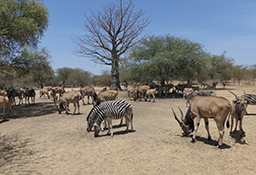
Senegal & the safari: two models, one animal
In Swahili, safari simply means “journey”. The word suits Senegal, where a safari is less a collection of pictures than a trip towards wildlife that nearly vanished. Hunting, land clearing and drought emptied much of the country of its large mammals over the 20th century. What you see today comes down to two answers to that void.
The first is the great national park. Niokolo-Koba National Park, straddling the Tambacounda and Kédougou regions, has been a UNESCO World Heritage Site since 1981. Poaching and various pressures led to its being placed on the List of World Heritage in Danger in 2007. On 24 July 2024, meeting in New Delhi, the World Heritage Committee removed it from that list, praising the conservation work. It still holds wildlife the rest of the country has lost, Derby eland, chimpanzees, large carnivores, but rare, shy and scattered over an immense territory.
The second is the fenced private reserve. From the end of the 20th century, forêts classées (protected forests) were restored, fences put up and animals reintroduced, many of them brought from other parts of Africa. Bandia, on the Petite Côte, is the best-known example; Fathala Reserve, in the Saloum, the most forested. This model has its critics, and makes no secret of it. But it plays a real role: Derby elands taken from Niokolo-Koba breed at Bandia and Fathala, in a programme monitored by scientists.
Formats: from a morning out to an expedition
- The Bandia safari: the savannah by vehicle with a guide, in the morning or for the day. The shortest route to a giraffe.
- Combined trips from Dakar or the Petite Côte: Bandia then the Somone lagoon, Bandia then the Lac Rose dunes by 4×4, or all three in the same day.
- Bandia and the lion encounter: the safari, then a neighbouring private site where lions used to humans live. There is also a day devoted to that site alone, transport and guide included.
- The three-day stay at Bandia: transport from your accommodation, two nights, meals, safari and a discovery of the Petite Côte.
- Fathala: a day of safari and lion encounter, or a two-day stay that adds the Sine-Saloum Delta.
- Niokolo-Koba: for a day or over two days, from Kédougou Region, for the savannah, the gallery forests and the wildlife.
- The birdwatching and photo safari: two hours or half a day in the Saloum Delta, on foot, by pirogue or by bike, guide, binoculars and notebook included.
An honest note: the Land Rover ride at Lac Rose carries the word “safari”, but it is an outing among dunes and salt, with no wild animals. It is worth it for the landscape, not for the wildlife.
Where to go on safari in Senegal
- Petite Côte: Bandia. Half an hour from Saly, one to two hours from Dakar depending on traffic. A private, fenced reserve: giraffes, zebras, buffalo, ostriches, several antelopes including the Derby eland, a few white rhinos, a crocodile pond. There are no lions or elephants in the reserve. The lions on the combined listings live at a separate private site, where you watch them from an enclosed vehicle.
- Sine-Saloum: Fathala. South of Toubacouta, near the border with the Gambia, in the forest of Saloum Delta National Park. Giraffes, zebras, Derby elands, western red colobus monkeys and forest birds. The walk with the lions is done on foot, in an enclosure, with keepers. Allow four to five hours by road from Dakar: stay the night.
- Eastern Senegal: Niokolo-Koba. The country’s only true wilderness, to combine with Kédougou, Bassari Country (Pays Bassari) and Dindéfélo. You go for the immensity and the chance of an encounter, never for a checklist.
- Saloum Delta: the birds. Bolongs (tidal creeks), mangrove and roosting sites, around Palmarin. Enthusiasts can carry on with birdwatching.
When to go
The dry season, from November to May, remains the best time. The grass dies back, the animals move closer to the waterholes and the tracks hold up. From November to February, mornings are cool and the light is soft: it is the ideal time for a first safari, and the one to aim for at Niokolo-Koba, because from March to May the south-east becomes the hottest part of the country.
During the rainy season (hivernage), from July to October, the savannah turns green and looks superb, but the tall vegetation hides the animals and some tracks get waterlogged. Bandia remains accessible, with time to spare on the journey; Fathala and above all Niokolo-Koba are best planned for the dry season.
The time of day matters as much as the month. Animals move about in the cool and take shelter when the sun climbs. A safari at opening time or late in the afternoon is easily worth two midday safaris.
Good to know & budget
On site. Neutral colours, a hat, water, sun cream, and binoculars if you have them: they transform the visit. Stay in the vehicle until the guide invites you to get out, and do not feed any animal, monkeys included. With the lions, every instruction from the keepers applies to the letter; age requirements are given on the listing. Bring cash in small notes: card terminals are rare outside the towns.
No sighting is guaranteed. The chances are good in a fenced reserve like Bandia, more random at Fathala, where the forest is dense, and very uncertain at Niokolo-Koba. Your guide knows where to look; the animals decide the rest.
What you pay. The price shown on each listing is the price of the service, usually per person; some outings require at least two participants, others offer a flat rate for a group. You pay 20% to secure your booking (the booking fee). The balance is paid on site, on the day. Live in Senegal? You get the resident rate: up to 30% off (the exact rate is shown on each listing).
Entry charges. Bandia, the lion site and Fathala are private sites: there is no public entry fee. Depending on the listing, entry, the reserve guide and the vehicle are either included or payable on site and not included in the price, and the listing gives the details. Entry to Niokolo-Koba, a national park, is an official fee, payable on site and not included in the price. In the Saloum Delta, the access permit for the marine protected area is also paid on site, at a rate that depends on your status, resident or not.
Who is it for?
Families should start with Bandia: a short journey, animals visible from the vehicle, and no big cats in the reserve to worry the youngest. Older children and teenagers will long remember the lions, at Fathala and near Bandia. Photographers will head for Fathala and the Saloum Delta, where you take time to wait and watch. Niokolo-Koba is for patient travellers who accept the road and the uncertainty.
If you live in Senegal, safari comes in two stages. One Saturday, Bandia from Dakar, with the Somone or Lac Rose in the afternoon, at the resident rate. Then, on a long weekend, Fathala with a night in the Saloum, or the end-of-year holidays towards Kédougou and Niokolo-Koba. If you are passing through, do not try to do it all: Bandia fits into a stay in Saly or a departure from Blaise Diagne International Airport (AIBD), Fathala into a stop in the Saloum. Niokolo-Koba on its own calls for several days of travel.
The Derby eland is the largest antelope in the world, and its West African subspecies survives in the wild only in small numbers, notably at Niokolo-Koba. A few individuals were captured there to be settled at Bandia. They bred, and the programme was extended to Fathala, monitored by a team of scientists. The stated goal: one day to send their descendants back to the park their ancestors came from. When an eland crosses your track at Bandia, a little piece of Niokolo-Koba is passing by.
Frequently asked questions
Which safari should I choose for my first time?
Bandia, on the Petite Côte: half an hour from Saly, one to two hours from Dakar, with giraffes, zebras and antelopes you watch from the vehicle. The outing can be combined with the Somone lagoon or Lac Rose in the same day.
Can you see lions and elephants in Senegal?
There are no lions or elephants in Bandia Reserve. Lions used to humans live at a private site next to Bandia and in an enclosure at Fathala, where you walk alongside them with keepers. In the wild, large wildlife survives mainly at Niokolo-Koba, where it is rare and never guaranteed.
Are the animals in the reserves wild?
Not in the sense of open bush. At Bandia and Fathala, giraffes, zebras and rhinos have been reintroduced and live in a fenced, managed area. Niokolo-Koba is the only park in the country where large wildlife lives without fences.
Is Niokolo-Koba still “in danger”?
No. Inscribed as a UNESCO World Heritage Site in 1981 and placed on the List of World Heritage in Danger in 2007, it was removed from that list on 24 July 2024 by the World Heritage Committee, in recognition of conservation efforts.
Do I need to pay an entry fee in addition to the price shown?
It depends on the listing. Bandia, the lion site and Fathala are private, with no public entry fee: entry is either included or payable on site and not included in the price, as the listing states. Entry to Niokolo-Koba and the permit for the Saloum marine protected area are official fees, payable on site and not included in the price.
How do I book?
You pay 20% to secure your booking (the booking fee), and the balance is paid on site, on the day. If you live in Senegal, you get the resident rate: up to 30% off (the exact rate is shown on each listing).